
Construction Procurement Software in India: Why Material Buying Is Still Broken
Construction procurement software in India fails for the same three reasons every time: prices move daily, tax rules change mid-project, and goods travel under documentation limits nobody modelled. A system that only holds a catalogue and a cart will break. It has to hold live pricing, GST logic, transport paperwork and payment terms in one place.
India builds at enormous scale. The country is the second largest cement producer in the world, with installed capacity of close to 700 million tonnes a year and production of 491.4 million tonnes in FY26, up 8.6 percent year on year, according to IBEF. Materials account for 50 to 60 percent of a typical house construction budget in India, with labour at 25 to 30 percent, per JK Cement’s 2026 cost guide.
And yet most of that buying still runs on phone calls, WhatsApp photographs of rate lists, and a diary at the site office. Every few months someone builds an app to fix it, and most of those apps quietly stop being used within a year. This post is about why, and what a procurement system actually has to do to survive contact with an Indian construction site.
Why material procurement in India is still broken
The problem is not that contractors dislike technology. It is that the trade has five structural features that ordinary e-commerce assumptions do not survive.
- The price is not a number, it is a negotiation. Cement and steel rates move with freight, plant dispatch, season and volume. A dealer quotes one rate to a builder buying 2,000 bags a month and another to a homeowner buying 200. A fixed catalogue price is wrong the moment it is published.
- Stock is real and local. A TMT bar listed as available is only available if it is available at a yard that can reach your site today. Availability is a function of distance and truck, not of a database flag.
- The buyer is not one person. A site engineer raises the requirement, a purchase manager approves the rate, the owner releases payment, and the storekeeper receives the goods. Four roles, four different screens, four different levels of trust.
- Delivery is the product. Nobody wins an order on catalogue depth. They win it because the truck arrived before the pour. Routing, partial deliveries and short supply are core features, not logistics afterthoughts.
- Money moves on credit, not on checkout. Material is bought on 30, 45 or 60 day terms against a running ledger. A payment gateway alone does not describe this business.
Any platform that ignores one of these five ends up as a very expensive order form that the site team bypasses within a month.
Five gaps construction procurement software must close
1. Live pricing, not a stored catalogue
Rates need a source, a timestamp and a validity window. The practical pattern is a base rate per supplier per material per delivery zone, adjusted by a quantity slab, with an expiry after which the rate has to be re-confirmed before an order can be placed. Quotes should be versioned so that when a buyer disputes a rate three weeks later, you can show which rate was live when they accepted it.
2. Tax logic that can be changed without a release
GST rates on building materials are not static, and hard-coding them is the single most common design error we see. Store the HSN code against the material, store rate history with effective dates against the HSN, and compute tax at the time of invoice from that table. Then a rate change is a data change, not a hotfix.
3. E-way bills generated from the order, not typed again
Most construction consignments cross the threshold that makes an e-way bill compulsory, so the document has to be produced from the same record that produced the invoice. Duplicate data entry between an accounting package and a procurement app is where mismatched invoice numbers and detained trucks come from.
4. Credit terms modelled as first-class data
Every buyer needs a credit limit, an exposure figure, an ageing view and a hard stop. Since 1 April 2024, Section 43B(h) of the Income Tax Act has disallowed a deduction for amounts owed to micro and small enterprises registered under the MSMED Act until they are actually paid, within 15 days, or 45 days where there is a written agreement. Separately, the MSME Ministry has required companies above 250 crore rupees of turnover to onboard onto TReDS platforms. Payment terms are now a tax and compliance question, which means your system has to know the supplier’s MSME status and invoice date, not just the amount due.
5. Reconciliation at the site, not at head office
Ordered, dispatched, delivered, received and consumed are five different quantities. Short supply, rejected loads and material issued to a subcontractor all have to be captured at the gate, on a phone, often without a network. Offline capture with later sync is not a nice-to-have in this category.
The tax and transport layer you cannot skip
Two pieces of Indian regulation shape the data model more than anything else.
GST rates change, and they changed recently. The 56th GST Council meeting moved the tax structure to a two rate framework of 5 percent and 18 percent with a 40 percent de-merit rate, and cut the rate on Portland and similar hydraulic cements from 28 percent to 18 percent, effective 22 September 2025, per the Press Information Bureau release on the Council’s recommendations. Bars and rods including TMT, classified under HSN 7213 to 7215, sit at 18 percent. Any platform that had 28 percent written into its checkout code had a bad week in September 2025. Any platform with a rate table had a five minute data update.
Goods move under a clock. Under rule 138 of the CGST Rules, an e-way bill is required where consignment value exceeds 50,000 rupees, and the bill’s validity is set by distance from the date of generation, as published by CBIC:
| Approximate distance | Validity of the e-way bill |
|---|---|
| Less than 100 km | One day |
| 100 km to 300 km | Three days |
| 300 km to 500 km | Five days |
| 500 km to 1,000 km | Ten days |
| 1,000 km and above | Fifteen days |
Read that table as a product requirement. A platform that lets a buyer place an order for a 700 km delivery has committed the supplier to dispatching inside a window, and the software should be telling the dispatch team that, not leaving it to a transporter to discover. Validity, vehicle number updates and consolidated bills for multi-drop trucks all belong in the order screen.
Build or buy: choosing construction procurement software
Three routes are realistic for an Indian materials business. The right one depends less on budget than on whether pricing and delivery are your competitive edge or just overhead.
| Factor | ERP procurement module | Generic B2B marketplace platform | Custom build |
|---|---|---|---|
| Daily price changes | Possible but clumsy, usually via price lists | Catalogue-first, slab pricing needs workarounds | Native, rates modelled with validity windows |
| GST and e-way bill | Strong if the ERP is India-built | Usually bolted on or manual | Built from your HSN and rate tables |
| Supplier onboarding | Internal vendors only | Good, standard KYC flows | Designed around how you verify yards |
| Site-level workflows | Weak, desktop assumptions | Weak, consumer assumptions | Built for a storekeeper with one hand free |
| Time to first live order | Weeks, if you accept the defaults | Weeks | Months, staged by module |
| Best when | You buy, you do not sell | You are testing demand | Procurement is the business |
If you are still testing whether buyers will order materials from a screen at all, do not start with a custom build. Start with the smallest thing that can take a real order and settle real money, and read our breakdown of MVP development cost in India by build stage before you fix a budget. If procurement itself is the product, a custom build is the only route that will hold the pricing and compliance logic above, and that is a custom software development project rather than a configuration exercise.
What Go Material taught us
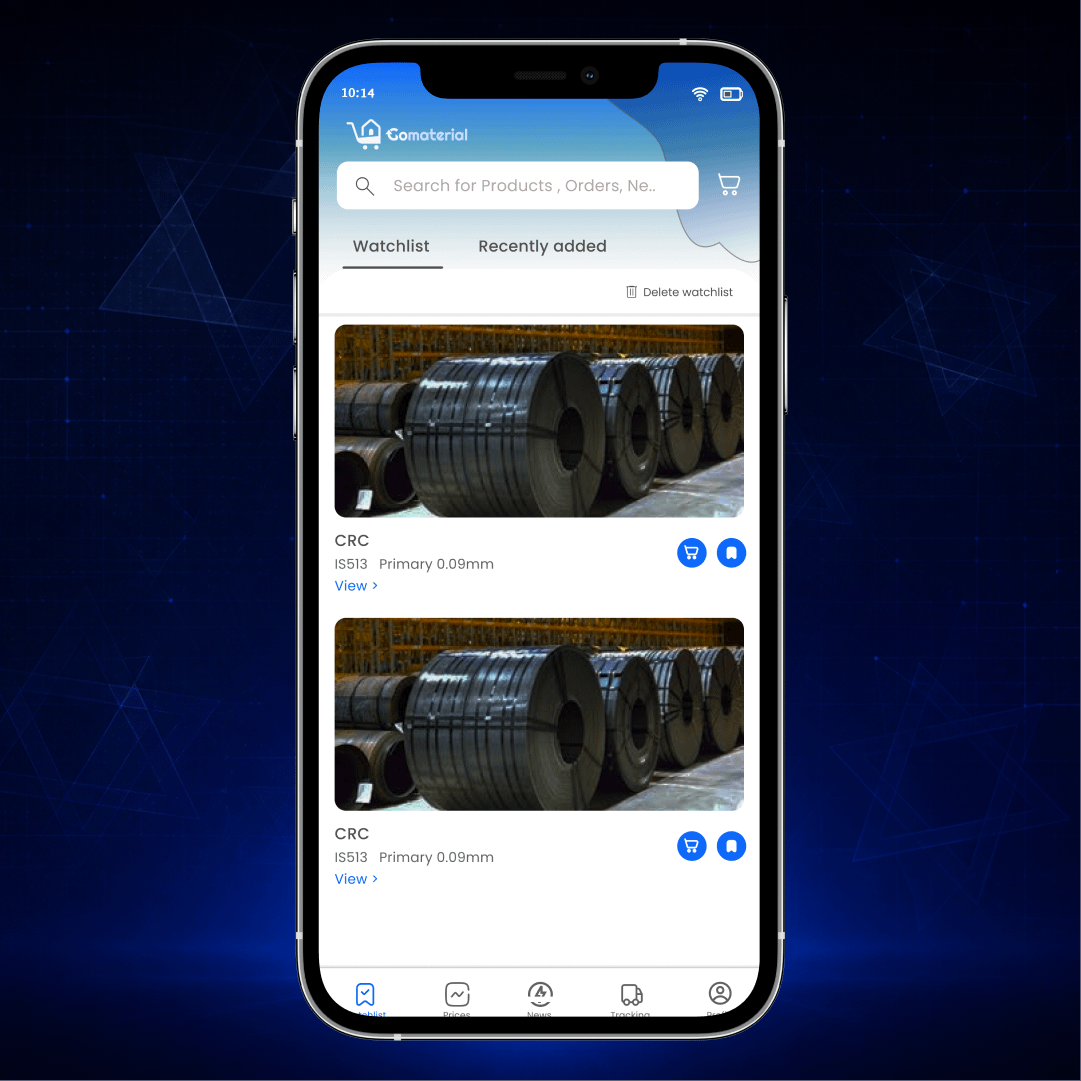
We built Go Material, a construction materials procurement platform, as a website plus Android and iOS apps. The product lets buyers find verified suppliers, compare prices, check live stock availability and arrange doorstep delivery, with secure payments, GST invoices, spend tracking, bulk discounts and returns. The live platform lists mild steel, TMT bars, stainless steel, pipes, polymers and packaging at live market prices with GST invoicing and pan-India delivery.
Three things stood out during that build.
First, supplier verification is a product feature, not an operations task. Buyers do not switch from a dealer they have used for a decade unless the platform can show them who is behind a listing.
Second, price comparison only works if the comparison is like for like. Two quotes for TMT are not comparable unless both include freight to the same pincode, the same grade, and the same tax treatment. Normalising that before display is most of the engineering.
Third, a materials platform is a two-sided market with an asymmetric cold start. Supply has to be live before demand shows up, and the supplier side needs its own app with inventory, rate updates and dispatch. We wrote about that pattern in more depth in our piece on building a two-sided marketplace. For the mechanics of the build itself, including inventory sync, GST invoicing and delivery, see our guide to building a construction materials marketplace.
Where to start
If you are scoping a procurement platform this quarter, work in this order. Model the rate first, with source, zone, slab and expiry. Then model the document chain, invoice to e-way bill to proof of delivery, from a single order record. Then add the buyer workflow with roles and approvals. Catalogue browsing, wishlists and recommendations can wait, because none of them are why a purchase manager will switch.
Get those three right and the platform survives a GST notification, a freight spike and a monsoon. Get them wrong and you have built a catalogue that a WhatsApp group will beat.
We build procurement and marketplace platforms for construction and industrial businesses from our base in New Delhi. If you want a second opinion on your scope before you commit a budget, book a product consultation about what your first release actually needs to contain. If you are still shortlisting partners, our 12-point checklist for choosing a software development company in Delhi NCR is a good place to begin.
[…] material suppliers across Android, iOS and web. We go deeper into that category in our guide to construction procurement software in India. Jerni matches passengers with verified drivers and fleet vendors in real time. One moves cement […]
[…] four are the product. If you are still deciding whether to build the platform at all, our piece on why construction procurement in India is still broken covers the demand side of the […]