

How to Build a Construction Materials Marketplace: Inventory Sync, GST Invoicing, Delivery
A construction materials marketplace is a platform where builders and homeowners buy cement, steel, sand and tiles from multiple verified suppliers in one order. The hard parts are not the catalogue. They are keeping stock accurate across suppliers, splitting one cart into GST-correct invoices, and moving heavy goods legally.
Most teams underestimate all three. A catalogue and a checkout can be built in weeks. Getting a truck of cement from a dealer’s yard to a site in Gurugram, with a valid invoice and a valid e-way bill, without promising stock that was sold an hour ago, is where the engineering actually lives.
India’s building materials market was worth about USD 44.4 billion in 2025 and is forecast to reach USD 64.5 billion by 2034, according to IMARC Group’s India building materials report. Almost none of that moves through software today. That gap is the opportunity, and it is also why the problems below have not been solved for you by an off-the-shelf product.
What a construction materials marketplace must actually do
Strip away the app screens and there are four jobs.
- Tell the truth about stock. A dealer’s yard is not a warehouse with a barcode scanner at every door. Quantities change through phone calls and walk-ins.
- Price correctly at the moment of order. Cement and steel prices move weekly. Freight is a function of distance, load and vehicle type, not a flat fee.
- Produce a compliant invoice. Multiple suppliers, multiple GST rates, multiple GSTINs, one customer cart.
- Get heavy goods to a site. Partial loads, a watchman who signs instead of the buyer, and a truck that cannot enter the colony before 10am.
Everything else is a feature. These four are the product. If you are still deciding whether to build the platform at all, our piece on why construction procurement in India is still broken covers the demand side of the argument.
Real-time inventory sync across suppliers
We go deeper on this in a dedicated piece on real-time inventory sync across multiple suppliers, covering rate limits, reservation ledgers and feed-silence alerting.
The honest answer is that real time does not exist in this category, and pretending otherwise is how marketplaces earn their first wave of cancellations.
Suppliers sit on a spectrum. A few run Tally or Busy with an API or a scheduled export. Most keep a register. Some will only answer WhatsApp. Your architecture has to accept all three without letting the weakest one degrade the buyer experience.
A workable pattern:
- Model stock as a claim, not a fact. Store quantity plus a confidence level plus a last-verified timestamp. The buyer app renders these differently: “In stock”, “Usually available”, “Check availability”.
- Make the source pluggable. One ingestion interface, several adapters: ERP pull, CSV or spreadsheet upload, a supplier web panel, and a WhatsApp or IVR confirmation loop for the register-and-pen dealers.
- Reserve on order, do not decrement on view. Hold quantity for a short window at checkout, release it on timeout. This alone removes most oversell.
- Add a confirmation gate for low-confidence stock. Order is placed, supplier has a fixed window to accept, buyer sees “confirming with supplier” rather than a false “confirmed”.
- Route to a second supplier on decline. If your catalogue is genuinely multi-supplier, a decline should trigger a fallback offer, not a refund.
- Score suppliers on acceptance and on-time delivery. Rank search results by it. Reliability becomes a commercial incentive instead of a support ticket.
The reservation window and the confirmation gate are the two pieces teams skip. They are also the two that decide whether the marketplace feels trustworthy in month three. The general two-sided dynamics here are the same ones we wrote about in building a two-sided marketplace, with the added twist that supply is physical, heavy and perishable in the pricing sense.
GST invoicing and the multi-rate cart
A single construction cart routinely spans four GST rates and two or three sellers. This is the part that breaks naive checkout code.
Rates changed materially in 2025. The 56th GST Council meeting cut cement from 28% to 18%, and the new rates took effect on 22 September 2025, per the official PIB release on the Council’s recommendations. Anything built before that date and never revisited is now invoicing at the wrong rate.
| Material | HSN | GST rate | Note |
|---|---|---|---|
| Cement | 2523 | 18% | Cut from 28% with effect from 22 Sep 2025 |
| TMT bars and steel | 7214 | 18% | Unchanged |
| Natural sand | 2505 | 5% | Unchanged |
| Clay and fly ash bricks | 6901 | 12% | Special composition options apply to brick makers |
| Sand lime bricks | 6901 | 5% | Cut from 12% with effect from 22 Sep 2025 |
| Marble and granite blocks | 2515 / 2516 | 5% | Cut from 12% with effect from 22 Sep 2025 |
Three design consequences follow.
Rates belong in data, not in code
Store HSN against every SKU, store rate against HSN with a validity date range, and compute tax at order time from the effective row. When the Council changes a rate, you insert a row. You do not ship a release. Historical invoices continue to reproduce correctly, which matters when a customer disputes a bill from eight months ago.
One cart, several invoices
If suppliers sell in their own name, each supplier’s lines become a separate tax invoice under that supplier’s GSTIN, with its own place of supply and its own CGST/SGST or IGST split. The buyer sees one order and one payment. The system issues several documents. Build the order model with that split from day one, because retrofitting it means rewriting returns, credit notes and reconciliation.
E-invoicing, TCS and TDS
E-invoicing under GST is mandatory for businesses with aggregate annual turnover above INR 5 crore, and taxpayers with turnover of INR 10 crore and above must report invoices to the Invoice Registration Portal within 30 days of issue. Practically, this means your platform either generates the IRN and QR code on the supplier’s behalf through an IRP or GSP integration, or it hands the supplier a clean document and a deadline. The first option is the one that scales.
If you are an electronic commerce operator collecting payment on behalf of sellers, you also collect TCS under section 52 of the CGST Act. The rate was reduced from 1% to 0.5% with effect from 10 July 2024, and it is filed monthly in GSTR-8. Budget engineering time for the GSTR-8 data pipeline, not just the deduction.
There is a commercial fork hiding in this section. If you buy and resell, you own one GSTIN, one invoice and simple tax, but you also own working capital and inventory risk. If you operate as a marketplace, you stay asset light and inherit the multi-invoice, TCS and reconciliation burden instead. Decide this before you write the order service, not after.
Delivery, e-way bills and proof of drop
Construction delivery is not last-mile parcel delivery with bigger boxes. A single order can be 200 bags of cement on a tipper and 40 sheets of plywood in a tempo, leaving two yards, arriving on different days.
E-way bills. An e-way bill is required for consignments above INR 50,000 for inter-state movement, with state thresholds varying for intra-state movement. Validity is one day per 200 km for regular cargo and one day per 20 km for over-dimensional cargo. Since 1 January 2025, e-way bills can only be generated against documents dated within 180 days, and extensions are capped at 360 days from generation, as ClearTax’s e-way bill guide sets out. Your dispatch flow needs to generate Part A and Part B, handle vehicle changes mid-route, and cancel cleanly when a delivery is aborted.
Split shipments as a first-class concept. One order, many consignments, each with its own vehicle, driver, e-way bill and delivery window. If your schema treats an order as one shipment, every real order becomes an exception.
Quantity variance on arrival. Sand and aggregate are sold by weight or volume and rarely arrive at exactly the ordered figure. Build a tolerance band, capture the delivered quantity at the site, and generate a debit or credit note automatically when actual and ordered diverge beyond it.
Proof of delivery that survives a dispute. Timestamped photographs, GPS coordinates, a signature, the name and role of whoever received it, and the challan number. Site handovers are frequently done by a supervisor or a watchman, so “buyer confirmed” is not a field you can rely on.
Driver app offline first. Sites in the outer NCR, and plenty of them inside it, have poor connectivity behind concrete. Queue the proof of delivery locally and sync when the signal returns.
Payments, escrow and credit
Money in this category does not behave like retail money. Orders are large, buyers expect credit, and suppliers want certainty before a truck leaves the yard.
If you collect on behalf of sellers, you are operating in payment aggregator territory. The RBI issued the Reserve Bank of India (Regulation of Payment Aggregators) Directions, 2025 on 15 September 2025, consolidating the rules on authorisation, merchant due diligence and permissible operations in escrow accounts. In practice most marketplaces route funds through an authorised payment aggregator and use its escrow or split-settlement product rather than holding funds themselves. Confirm the split settlement, hold and release capabilities with your provider before you design the payout ledger, because the ledger has to mirror what the provider can actually do.
Three more things worth designing early:
- Partial payment against partial delivery. If half the order lands today, the payout, the invoice and the ledger all need to agree on what is owed.
- Credit terms per buyer. Contractors buy on 15 or 30 day terms. A credit limit, an exposure calculation and an ageing report are core features, not finance team spreadsheets.
- A reconciliation view from day one. Orders, invoices, IRNs, settlements, TCS and refunds must line up. Retrofitting reconciliation after a thousand orders is one of the most expensive rescues we see.
Build order for a construction materials marketplace
A sensible sequence for a construction materials marketplace, assuming you want revenue before you want scale:
- One city, one category, ten suppliers. Cement and steel are enough to prove demand. Depth beats breadth here.
- Supplier panel before buyer app. If suppliers will not keep prices and stock current on a web panel, no mobile app saves you.
- Order, reservation and confirmation gate. The trust mechanics described above.
- Invoicing with HSN-driven rates and multi-seller splits. Wire in e-invoicing as soon as any supplier crosses the turnover threshold.
- Dispatch and e-way bill generation. Plus the driver app with offline proof of delivery.
- Payments, payouts and reconciliation. Then credit terms once you know who your repeat buyers are.
- Pricing intelligence and reorder prompts. Only once there is transaction history worth learning from.
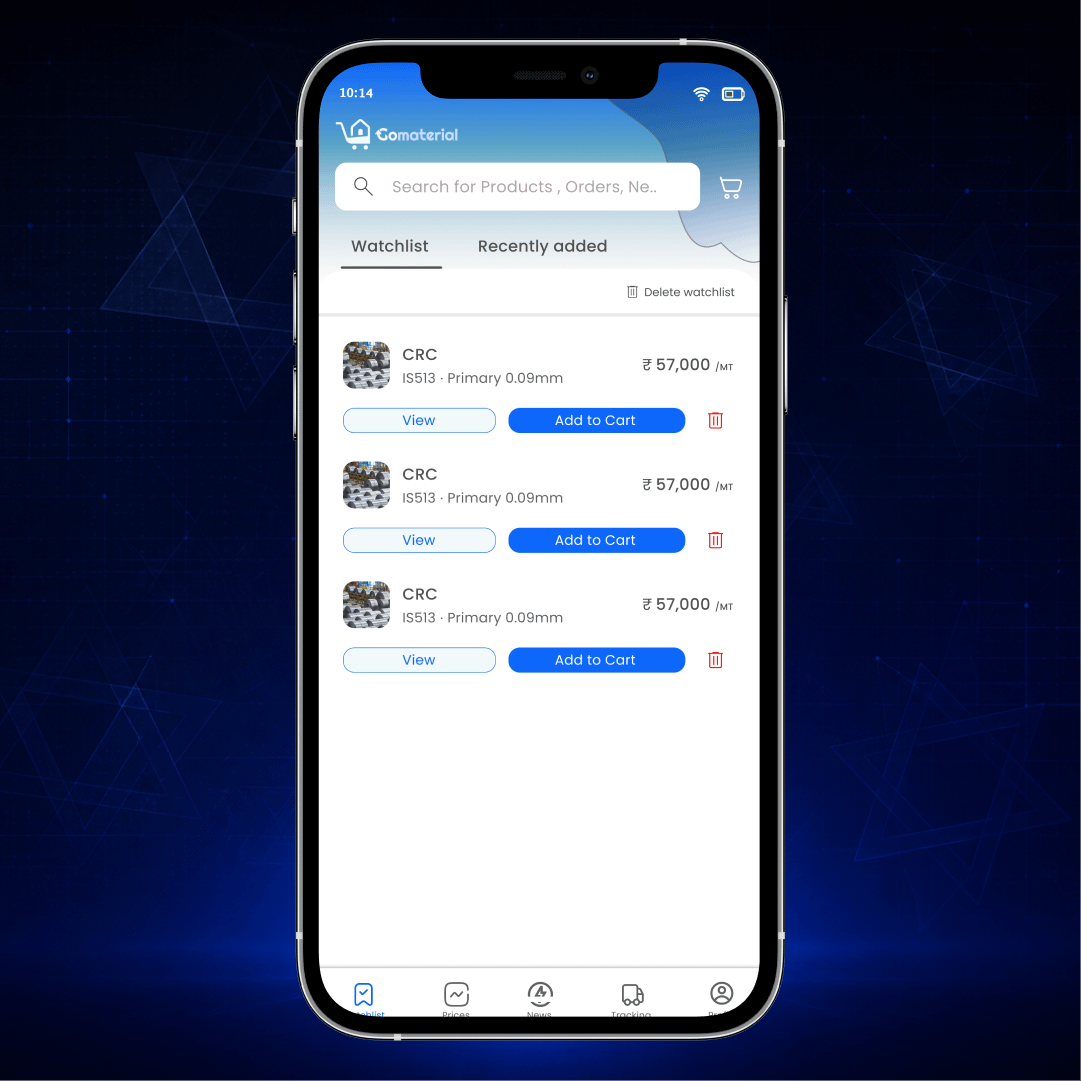
Go Material, which we built, follows roughly this shape: verified supplier discovery, live stock, price comparison, scheduled doorstep delivery, GST invoice generation and expense tracking in one app. The Go Material case study covers the product scope in more detail.
What drives cost and timeline
We will not quote a number here, because the range is wide and driven by decisions you have not made yet. What we can name are the drivers, roughly in order of impact.
| Driver | Why it moves the number |
|---|---|
| Marketplace vs reseller model | Multi-seller invoicing, TCS and payouts add substantial scope over a single-GSTIN resale flow |
| Number of inventory integration types | Each adapter (ERP, CSV, panel, WhatsApp) is separate build and support work |
| In-house logistics vs partner fleet | A driver app, routing and vehicle management is a product in its own right |
| E-invoicing and e-way bill automation | IRP or GSP integration, error handling and cancellation flows |
| Credit and ledger depth | Limits, ageing, statements and collections push this toward fintech complexity |
| Apps required | Buyer, supplier, driver and internal ops are four surfaces, not one |
If you want grounded benchmarks for an early build, our breakdown of MVP development cost in India gives stage-by-stage market ranges you can sanity-check a quote against.
Where to start
The pattern we see work is narrow and deep: one city, a handful of materials, suppliers who will actually keep stock current, and an invoicing layer that is right before the volume arrives. Fix stock truthfulness and GST correctness first. Catalogue breadth is the easy part and it can wait.
If you are scoping a construction materials marketplace and want a second opinion on the model, the integrations or the sequence, talk to our custom software development team. Bring your supplier list and we will tell you honestly which parts of it are integrable.
[…] Third, a materials platform is a two-sided market with an asymmetric cold start. Supply has to be live before demand shows up, and the supplier side needs its own app with inventory, rate updates and dispatch. We wrote about that pattern in more depth in our piece on building a two-sided marketplace. For the mechanics of the build itself, including inventory sync, GST invoicing and delivery, see our guide to building a construction materials marketplace. […]
[…] Budget staff time for both, not just developer time. The same lesson showed up when we wrote about building a construction materials marketplace: inventory and catalogue quality decide whether the software looks smart or […]
[…] We covered how this plays out in a materials catalogue in our guide to building a construction materials marketplace. […]