
Interior Design App Development: What We Learned Building Airbrick
Interior design app development means building four connected things at once: a customer app that shows rooms in 3D, a design library that loads fast on a mid-range phone, a quoting engine that produces a GST-correct invoice, and an ops dashboard that tracks site visits and installation. Skip any one and the project stalls.
We learned that the hard way while building Airbrick, a commercial interior design app and design library. The inspiration feed is the easy part. What breaks projects is everything after a customer taps “I like this”: the estimate, the site visit, the material list, the invoice, and the six weeks of installation nobody designed a screen for.
This post sets out what the category actually requires, what the 3D and AR layer costs you in engineering time, what published rate benchmarks say about budgets in India, and the build order we would follow again.
What an interior design app is actually for
The market is large and growing steadily. IMARC puts the India interior design market at USD 39.90 billion in 2026, up from USD 36.89 billion in 2025, and projects USD 74.73 billion by 2034 at a CAGR of 8.16 percent. That growth is not being won by whoever has the prettiest gallery. It is being won by firms that can quote faster and execute more predictably than the local contractor.
So the useful way to scope an interior design app is to map it to the six stages of an actual interiors deal, not to app screens:
- Discovery. The customer browses work that resembles their space. Filters matter more than search.
- Scoping. Carpet area, number of seats or rooms, finish level, timeline.
- Estimate. A number the customer can take to a boss or a spouse.
- Site visit. A measured survey, usually the first real commitment from both sides.
- Execution. Materials ordered, vendors scheduled, milestones signed off.
- Handover. Snag list, warranty, final payment.
Most apps in this category cover stage one well and stages two to six badly. The revenue sits in stages three to five.
Interior design app development: the six modules that matter
Here is how we break the scope down, and the failure we see most often in each module.
| Module | What it has to do | Most common failure |
|---|---|---|
| Design library and search | Faceted browsing by zone, space size, location and style, with saved collections | Free text search over untagged images, so nothing is findable |
| 3D and AR visualisation | Show the space believably on the device the customer owns | One heavy 3D path that only runs on flagship phones |
| Cost estimator | Produce a tiered estimate from area and finish level in under a minute | A single blended number the sales team then contradicts |
| Site visit and consultation booking | Slot booking tied to a real designer calendar and a serviceable pincode | A contact form, so 60 percent of intent leaks to WhatsApp |
| Project tracker | Stage status, dated site photos, approvals and payment milestones | Built as a read-only status page with no sign-off, so disputes have no record |
| Vendor and procurement back office | Catalogue, purchase orders, GST invoicing, delivery status | Left to spreadsheets, which breaks the moment you run two cities |
Two of these are content operations rather than software features. A design library is only as good as the taxonomy behind it, and a catalogue is only as good as the vendor data feeding it. Budget staff time for both, not just developer time. The same lesson showed up when we wrote about building a construction materials marketplace: inventory and catalogue quality decide whether the software looks smart or stupid.
The 3D and AR layer: what works on Indian phones
This is where budgets get burned. Three things are worth knowing before you commit.
AR support is narrower than the demo suggests
On Android, augmented reality runs through ARCore, and ARCore only runs on devices Google has certified for camera, sensor and CPU performance. Google’s own device documentation notes that over 88 percent of active ARCore devices support the Depth API as of May 2026, but that percentage is of the certified pool, not of every Android phone in India. Plenty of budget handsets in active use are outside it entirely. Build AR as an enhancement with a graceful fallback, never as the primary way to see a design.
You will maintain two asset formats
iOS viewing through AR Quick Look expects USDZ. Android and the web expect glTF or GLB. That means a single 3D sofa becomes two exported files, two compression passes and two sets of visual checks. Decide early whether your design team or your build partner owns that pipeline, because it is recurring work, not a one-time conversion.
Pre-rendered often beats real time
A 30 second walkthrough video, a set of 360 degree panoramas, or server-rendered stills will load on any phone on a 4G connection and look better than a real-time scene constrained to run on mid-range hardware. For most Indian customers this is the honest choice. Keep live AR for the one or two moments where placement genuinely helps, such as checking whether a wardrobe fits a wall.
Interior design app development cost in India
We do not publish our own rate card here, so use published benchmarks. Clutch’s app development pricing guide, updated 21 September 2026, lists India hourly rates at under USD 25 per hour, a typical project band of USD 10,000 to USD 49,999, an average project cost across its directory of USD 90,780 and an average timeline of 11 months. At about INR 96 to the dollar, the rate quoted on 25 September 2026, that typical band is roughly INR 9.6 lakh to INR 48 lakh, and the directory average is closer to INR 87 lakh.
Where an interiors product lands inside that band depends on a short list of drivers:
- Number of surfaces. A customer app plus a design library website plus a company site plus an admin panel is four front ends, not one.
- 3D and AR depth. Static images, then 360 panoramas, then real-time 3D, then live AR. Each step up roughly doubles the visualisation effort.
- Estimator complexity. Area times rate is a weekend. Area, zone mix, finish tier, city and material availability is a proper rules engine.
- Procurement and invoicing. GST-correct documents, purchase orders and vendor payouts add integration and testing work most estimates miss.
- Content volume. Tagging and ingesting tens of thousands of design images is an operations cost with its own tooling.
- Multilingual and multi-city. Not just string translation, but pincode serviceability, city rate cards and local vendor lists.
Two small costs that belong in every budget: Google Play charges a one-time USD 25 developer registration fee, and the Apple Developer Program is USD 99 a year, with enrolment in India available only through the Apple Developer app. Then there is maintenance. Google Play’s published target API level policy requires new apps and updates to target Android 16, API level 36, from 31 August 2026, with extensions available to 1 November 2026. An app you ship and forget stops being updatable. For a wider view of these numbers across categories, see our breakdown of mobile app development cost in India.
What we learned building Airbrick
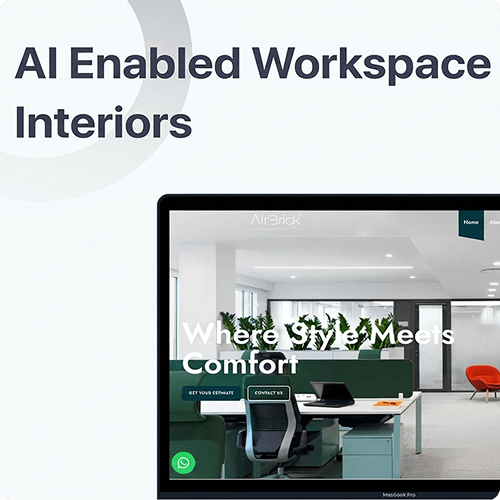
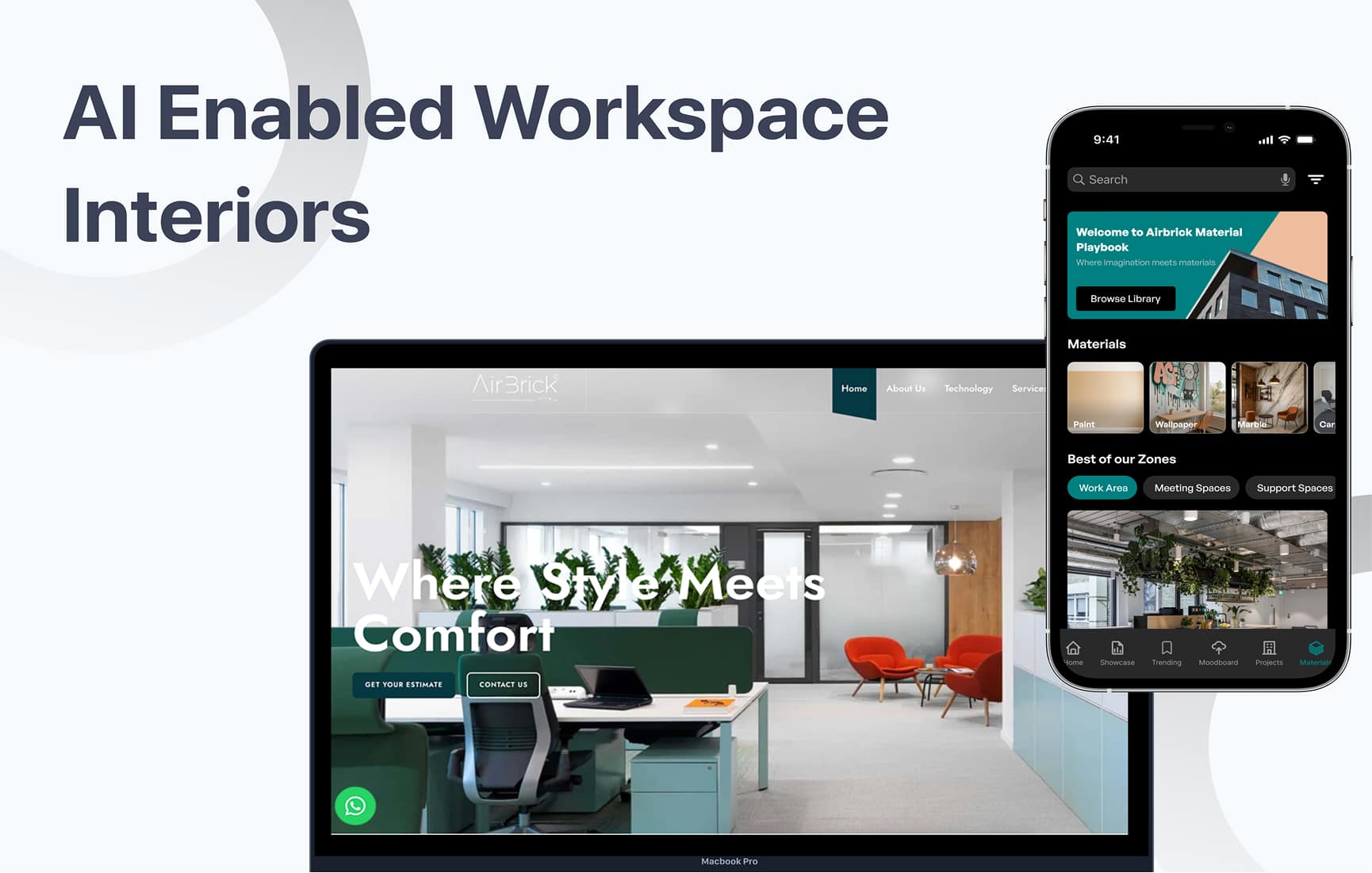
Airbrick is a commercial interiors firm, so the buyer is a facilities head or an admin lead, not a homeowner. Our scope covered product consultation, the customer app on Android and iOS, the design library on web, and the company website. The platform side included 3D and AR visualisation, a cost estimator, a project tracker, site visit booking, e-commerce procurement with secure payments, admin dashboards, vendor onboarding, multilingual support and a CMS.
Four things transferred to every interiors project we have scoped since.
Commercial buyers decide in groups
Airbrick’s published app describes browsing more than 100,000 commercial interior images, filtering by zone, location, size and design style, saving favourites into collections, and creating mood boards in three steps. That shape is not accidental. A facilities head does not pick a design, they assemble a shortlist to defend to a committee. Shareable collections and mood boards are the core feature, not a nice extra. A single-user wishlist would have been the wrong model.
Estimates need tiers, not a number
Airbrick’s own cost estimator produces figures across budget, premium and luxury standards. That is the right pattern. One number invites an argument, three tiers turn the conversation into a choice, and the sales team stops contradicting the app.
Use the trade’s vocabulary in your facets
Commercial interiors talk about zones, cabins, workstations and meeting rooms, not bedrooms and living rooms. Facet names taken from consumer home apps quietly make a professional product feel amateur. Build the taxonomy with the client’s project managers before designing a single filter screen.
The library is a publishing system
Airbrick’s site advertises more than 20,000 design options and 3D project walkthroughs. Volume at that level makes image pipelines, CDN delivery, tagging workflows and CMS ergonomics into first-order concerns. Interior design app development at scale is closer to running a media property than to shipping a utility app.
GST, quotes and invoices
An interiors quote is rarely one tax line. Design and consultancy is a service under SAC 998391, taxed at 18 percent. Furniture, fittings and materials you supply carry their own goods rates. Turnkey design and build work may be treated as a works contract. Since 22 September 2025, following the GST Council’s rate rationalisation, the structure runs mainly on two slabs of 5 and 18 percent, which simplifies goods rates but does not remove the need to tax each line correctly.
The practical implication for your build:
- Store a tax rate per catalogue line, never a single blended rate on the quote header.
- Keep the estimate and the tax invoice as separate documents with separate numbering. Estimates change, invoices must not.
- Capture the customer’s GSTIN at quote stage if they are a business, because commercial clients will want input credit and reissuing invoices is painful.
- Decide who raises the invoice when a vendor supplies directly, and model that in the data before you write the payout logic.
Room photos are personal data
An interiors app collects photographs of the inside of people’s homes and offices, floor plans, site addresses and phone numbers. Under Indian law that is personal data, and the compliance clock is running. The Digital Personal Data Protection Rules were notified on 14 November 2025 with an eighteen month phased compliance period, and the rules require data fiduciaries to act on access, correction and erasure requests within ninety days.
Four things to get right in the build:
- Notice and consent at the point of upload. A clear purpose statement when the customer photographs a room, not a buried policy link.
- Retention. Site photographs accumulate forever by default. Set a retention period and implement deletion, because you will be asked to.
- Erasure that actually works. Deleting a row is not enough if the same image sits in a CDN cache, a backup and a rendering vendor’s bucket.
- Third-party rendering. If you send customer room images to an external AI or rendering service, that is a processor relationship and it needs a contract and a data flow you can describe.
The build order we recommend
If we started a new interiors product tomorrow, this is the sequence we would follow, and roughly why.
- Taxonomy and catalogue schema first. Zones, styles, materials, finish tiers. Everything downstream inherits these names.
- Design library on the web. Indexable, cheap to iterate, and it starts earning organic traffic while the app is still being built.
- Tiered estimator with lead capture. The first module that produces revenue signal rather than engagement.
- Site visit booking tied to real calendars and serviceable pincodes. Do not launch a booking flow that cannot say no.
- Mobile app for collections and mood boards. Ship once there is enough content to browse.
- Visualisation, escalating. Panoramas, then real-time 3D, then AR where placement genuinely helps.
- Project tracker and procurement back office. Build these when you have signed projects to track, not before.
Sequenced this way, interior design app development stops being one large bet and becomes six smaller ones, each of which can be judged on its own. The pattern mirrors what we described in our home services app development playbook from HouseBanao and Hozo, where booking and scheduling had to work before anything clever was added on top.
If you are scoping an interiors product and want a straight opinion on which of these seven steps you actually need this year, talk to us about mobile app development for interior design platforms. We will tell you what to cut.
[…] If your service is interiors rather than repairs, the module list changes but the sequencing logic does not. We set that out in our guide to interior design app development. […]