
CRM Development Cost in India: Modules, Timelines and Price Drivers
CRM development cost in India is best estimated as hours multiplied by an hourly rate, not as a single headline quote. Indian agency rates sit between $25 and $75 an hour in FullStack Labs’ 2026 price guide, which is roughly ₹2,400 to ₹7,200. A lean sales CRM of 300 to 450 hours therefore lands near ₹7 lakh to ₹32 lakh.
That spread is the honest answer, and the rest of this post is about narrowing it. The number you end up paying depends on how many modules you build, how deep your integrations go, and how much compliance work sits underneath. Those three things are knowable before a single line of code is written, which means the quote you get should be explainable line by line.
Hourly rates for Indian development teams are published in FullStack Labs’ 2026 software development price guide, which puts India agency work at $25 to $75 per hour against $100 to $300 for a mid-market US firm. At about ₹96 to the dollar in early October 2026, that is ₹2,400 to ₹7,200 an hour. Where a given team sits in that band comes down to seniority mix, whether product and QA are included, and whether you are buying a team or buying an outcome.
What drives CRM development cost in India
Four variables move the price more than anything else. Everything else is noise by comparison.
- Module count. A CRM is not one product. Lead capture, pipeline, calling, quoting, invoicing, reporting and admin are separate builds that share a data model. Each one you add is real engineering time, not a toggle.
- Integration depth. Reading data from one external system is cheap. Writing to it, reconciling failures, and keeping two systems in sync when either can be the source of truth is where weeks go.
- Roles and permissions. A CRM used by five people needs almost no access control. One used by a 60-person field team with regional managers needs a permission model designed up front, because retrofitting it means touching every query.
- Compliance scope. GST invoicing, consent capture and call recording storage each carry rules that are not optional, and each adds work that does not look like a feature to the person paying for it.
Notice what is missing from that list: user count. SaaS pricing scales with seats, custom build cost does not. This is the single biggest structural difference between the two models and it is the whole basis of the break-even calculation further down.
Module by module: hours and rupees
The table below gives typical effort per module for a web CRM with an admin panel, and converts it at the two ends of the Indian agency rate band. Hours are engineering plus QA. Design, project management and deployment sit on top, usually adding 15 to 25 percent.
| Module | Typical effort | At ₹2,400/hr | At ₹7,200/hr |
|---|---|---|---|
| Lead capture, forms, deduplication | 60 to 90 hrs | ₹1.4 L to ₹2.2 L | ₹4.3 L to ₹6.5 L |
| Pipeline, stages, activity timeline | 80 to 120 hrs | ₹1.9 L to ₹2.9 L | ₹5.8 L to ₹8.6 L |
| Calling and call logging (telephony API) | 70 to 110 hrs | ₹1.7 L to ₹2.6 L | ₹5.0 L to ₹7.9 L |
| Quotations and GST invoicing | 100 to 160 hrs | ₹2.4 L to ₹3.8 L | ₹7.2 L to ₹11.5 L |
| Role-based access and admin panel | 70 to 120 hrs | ₹1.7 L to ₹2.9 L | ₹5.0 L to ₹8.6 L |
| Reporting and dashboards | 60 to 100 hrs | ₹1.4 L to ₹2.4 L | ₹4.3 L to ₹7.2 L |
| Mobile app for field sales | 200 to 320 hrs | ₹4.8 L to ₹7.7 L | ₹14.4 L to ₹23.0 L |
| WhatsApp and email automation | 50 to 90 hrs | ₹1.2 L to ₹2.2 L | ₹3.6 L to ₹6.5 L |
Read this as a menu, not a bill. Almost nobody needs all eight on day one. The cheapest useful CRM is lead capture plus pipeline plus a thin admin panel, and that is the 300 to 450 hour build quoted at the top.
Two modules deserve a warning. GST invoicing looks small and is not, because invoice numbering, credit notes, place-of-supply logic and the IRP round trip all have to be right the first time. And a field sales mobile app is close to a second product: offline behaviour, location permissions and store review cycles are costs that do not exist on web.
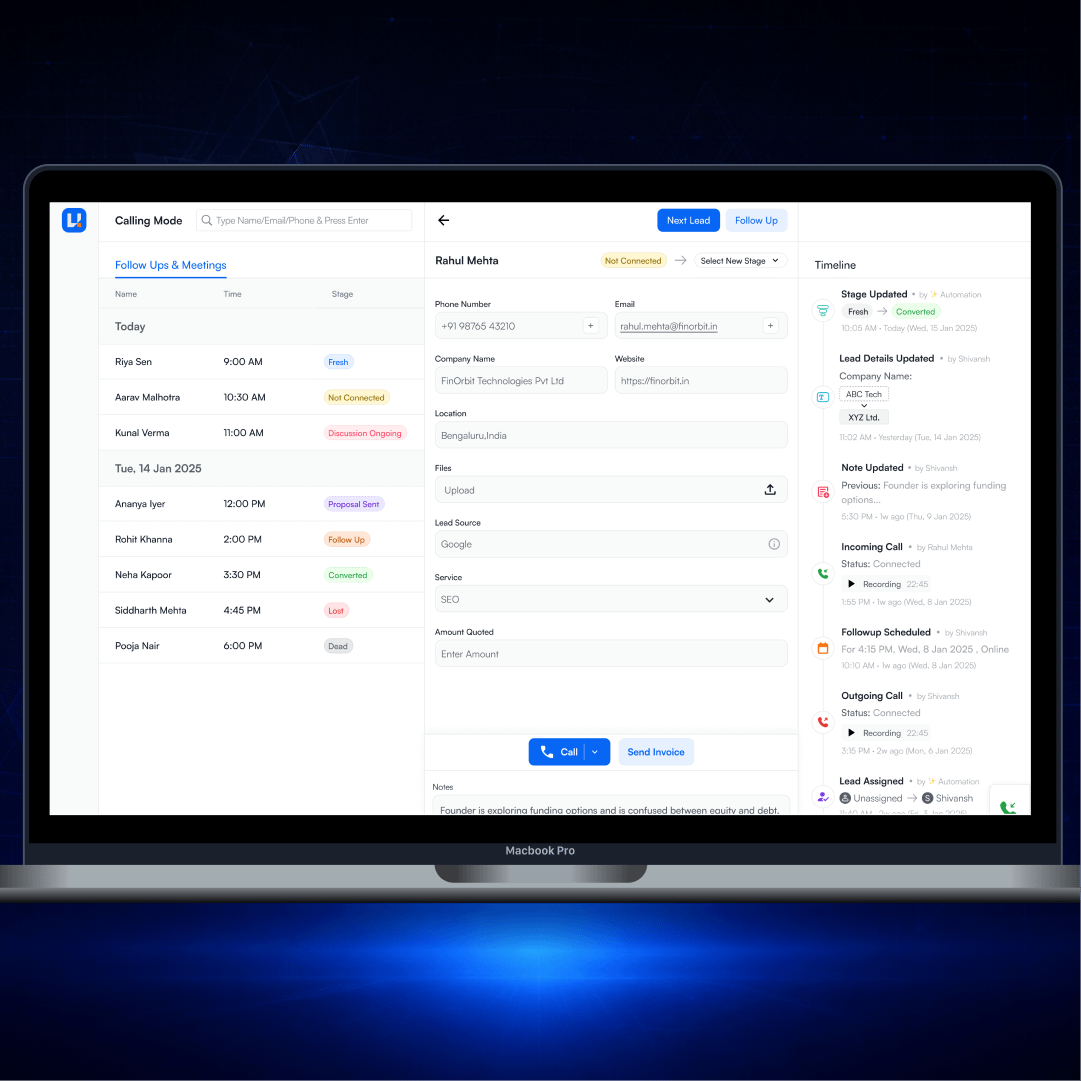
When we built UNA-CRM, a calling-first sales CRM, the scope was deliberately narrow: an agent panel, an admin panel, and a one-lead-at-a-time calling workflow with notes and follow-ups. That narrowness is a budget decision as much as a design one.
Build or licence: where the break-even sits
Licensed CRM is cheap to start and gets more expensive every year you grow. Custom is the reverse. The crossing point is arithmetic, and it is worth doing before you commit either way.
Zoho’s published India pricing starts at ₹800 per user per month for the Standard edition, ₹1,400 for Professional and ₹2,400 for Enterprise, before GST. Those are the rates most Indian SMBs actually compare against, and they are reasonable rates for what you get.
| Team size | Licence at ₹1,400/user/month | Over 3 years | Lean custom build, lower band |
|---|---|---|---|
| 10 users | ₹1.68 L / year | ₹5.0 L | ₹7 L to ₹11 L |
| 25 users | ₹4.20 L / year | ₹12.6 L | ₹7 L to ₹11 L |
| 60 users | ₹10.08 L / year | ₹30.2 L | ₹7 L to ₹11 L |
| 150 users | ₹25.20 L / year | ₹75.6 L | ₹7 L to ₹11 L |
The custom column does not move with headcount, which is the point. At 10 users, licensing wins comfortably. Somewhere around 25 to 30 users on a mid-tier plan, three-year licence spend catches a lean custom build. Past 60 users the gap stops being close.
Three caveats keep this honest. Custom carries ongoing cost too: hosting, maintenance and a share of a developer’s time, which realistically runs 15 to 20 percent of build cost per year. Licensed CRM gives you features on day one that would take you a year to build. And a bad custom build is worse than any licence. We went through this decision in more detail in our guide to custom CRM versus off-the-shelf for Indian SMBs.
The strongest case for building is not cost at all. It is when your sales process is genuinely unusual, when the CRM has to carry a workflow no product category has a template for, or when your data cannot sit in someone else’s tenancy.
The compliance work most CRM budgets miss
This is where Indian CRM projects overrun. Three obligations apply to most builds and none of them appear in a feature list.
GST e-invoicing
If your CRM raises invoices, e-invoicing rules apply once aggregate turnover crosses the threshold. Per ClearTax’s e-invoicing guide, e-invoicing has applied to registered persons with aggregate turnover above ₹5 crore since 1 August 2023, and following a GSTN advisory of 5 November 2024, from 1 April 2025 those taxpayers must report e-invoices to the Invoice Registration Portal within 30 days of the invoice date. For a CRM that means IRN generation, failure handling, a retry queue and a 30-day clock you have to enforce in code. Budget 40 to 80 hours for the integration alone, separate from the invoicing UI.
DPDP compliance
A CRM is a personal data store by definition. The Digital Personal Data Protection Rules were notified by MeitY on 14 November 2025 with an eighteen-month phased compliance window, which puts the far end of that window in mid-2027. In practice a CRM has to be able to record what a contact consented to and when, honour erasure requests without breaking referential integrity, and keep an audit trail of who accessed what. Designing for that at the start is cheap. Retrofitting it is not.
Telecom rules for outbound messaging
Commercial SMS in India runs through the DLT framework, so sender IDs and message templates have to be registered before your CRM can send anything. WhatsApp messaging carries per-message platform fees that sit outside the build cost and should be modelled separately in your running budget. Neither is expensive engineering, but both are gating items that block go-live if left to the last week.
Timelines: what each phase actually takes
Cost and calendar are not the same thing. A 450-hour build does not take 450 hours of calendar time, and adding people does not compress it linearly.
- Discovery and process mapping, 1 to 2 weeks. Watching how your sales team works today. Skipping this is the most expensive saving available.
- Data model and permission design, 1 week. Entities, relationships, roles. Changing this later is the costliest change there is.
- UI design, 2 to 3 weeks. Runs partly in parallel with the above.
- Core build, 6 to 10 weeks for a lean CRM. Longer if invoicing or a mobile app is in scope.
- Integrations, 2 to 4 weeks. Telephony, email, GST, payment. Always slower than estimated because you are dependent on someone else’s sandbox.
- Migration and UAT, 2 to 3 weeks. Importing years of messy spreadsheet data is its own project.
- Rollout and training, 1 to 2 weeks. Adoption fails here, not in the code.
A lean CRM is 12 to 16 weeks end to end. A multi-module platform with a mobile app is 24 to 36 weeks. If someone quotes you six weeks for the second one, the estimate is missing phases, not working faster.
CRM development cost in India by company size
Pulling the modules, the rate band and the phase list together, CRM development cost in India tends to cluster into three shapes.
| Profile | Scope | Effort | Indicative range |
|---|---|---|---|
| Small sales team, 5 to 20 users | Lead capture, pipeline, admin panel, basic reports | 300 to 450 hrs | ₹7 L to ₹32 L |
| Growing SMB, 20 to 75 users | Above plus calling, quoting, GST invoicing, roles | 700 to 1,100 hrs | ₹17 L to ₹79 L |
| Multi-branch or field-heavy, 75+ users | Above plus mobile app, automation, deep integrations | 1,400 to 2,200 hrs | ₹34 L to ₹1.6 Cr |
The ranges are wide because the rate band is wide, and the rate band is wide for real reasons. A two-person shop at the bottom of it and a team with product managers, designers and dedicated QA at the top are not selling the same thing. When you compare quotes, compare what is inside the hour before you compare the hour.
Where to cut cost without crippling the CRM
Some savings are free and some are borrowed against next year. The difference matters.
- Cut modules, not quality. Shipping three modules well beats shipping seven half-built. You can add the rest once people are actually using it.
- Use a telephony or messaging provider rather than building the plumbing. Nobody is going to thank you for a bespoke call stack.
- Defer the mobile app. A responsive web CRM covers most field use until the workflow is proven.
- Do not defer the permission model. This is the one that gets retrofitted at four times the price.
- Do not skip migration planning. Dirty data is the most common reason a new CRM gets abandoned in month two.
- Design the scoring and routing rules with the sales team, not for them. Our post on lead scoring rules sales teams actually trust covers why this is a cost item disguised as a design item.
One more decision affects total cost over a year more than any feature choice: whether you buy a fixed-scope project or an embedded team. We ran the twelve-month numbers on both in our comparison of staff augmentation versus fixed-price delivery.
Getting a real number for your build
A credible CRM quote should show you hours by module, name the integrations in scope, state what happens to compliance work, and separate build cost from annual running cost. If a quote is one number with no breakdown, you cannot tell whether it is cheap or whether it is missing half the work.
If you want that breakdown for your own process, our CRM development services team can map your sales workflow and put module-level hours against it, so you are comparing a scope rather than a headline figure. Send us what your team does today and we will tell you what it would take to build.
[…] Custom is not automatically cheaper, and we say so to clients who ask. It becomes the better economics when the recurring licence line is large, when your workflow is genuinely unusual, or when the standard product forces process changes your team will not accept. We have broken down both sides of that decision in our framework for choosing custom CRM versus off the shelf, and the build side numbers in our guide to CRM development cost in India. […]
[…] this alongside other roadmap work, our breakdowns of mobile app development cost in India and CRM development cost in India give a sense of what comparable engineering blocks run to, and our 12-point checklist for choosing […]