Custom CRM vs Off-the-Shelf: A Decision Framework for Indian SMBs
Custom CRM vs off-the-shelf comes down to arithmetic, not ideology. Buy off-the-shelf when your sales process looks like everyone else’s and you need it running this month. Build custom when your process is the thing that makes you money, when per-user licensing is about to punish you for growing, or when the CRM has to talk to systems no vendor supports. For most Indian SMBs the honest answer depends on three numbers, set out below.
This decision gets argued on ideology and settled on arithmetic. Here is the arithmetic.
What each option actually costs in India
Start with subscription pricing. Zoho CRM in India for 2026, billed annually and excluding 18 percent GST, per published India pricing:
| Plan | Annual billing | Monthly billing |
|---|---|---|
| Free | ₹0 | ₹0 |
| Standard | ₹800 per user per month | about ₹960 |
| Professional | ₹1,400 per user per month | about ₹1,680 |
| Enterprise | ₹2,400 per user per month | about ₹2,880 |
| Ultimate | ₹2,600 per user per month | about ₹3,120 |
Now custom development. Published Indian build costs for 2026 fall into three tiers:
- Basic CRM, ₹80,000 to ₹1,50,000. Lead capture, assignment, reminders, notes, simple dashboards.
- Automated CRM, ₹1,50,000 to ₹3,50,000. Pipeline stages, lead scoring your sales team will actually trust, quotations, workflow automation, integrations.
- Enterprise CRM, ₹3,50,000 and up. Multi-branch structures, custom workflows, ERP or POS integration, mobile apps.
The three numbers that decide custom CRM vs off-the-shelf
Number one: your seat count in three years
Subscription cost scales with headcount. Build cost does not. That single difference drives most of the outcome.
Take a ten-person sales team on Zoho Professional at ₹1,400 per user per month. That is ₹1,68,000 a year, ₹8,40,000 over five years, before GST and before implementation. An automated custom CRM at ₹3,50,000 upfront has paid for itself somewhere in year three, and every year after that is close to free apart from hosting and maintenance.
Published five-year comparisons for a ten-user team put Zoho at roughly ₹4.8L to ₹16.8L, HubSpot at ₹2.4L to ₹12L, and Salesforce at ₹21L to ₹90L. Against those, custom builds break even in three to five years, and considerably faster at the Salesforce end.
Invert it if your team is small and staying small. Four users on Zoho Standard is ₹38,400 a year. A custom build almost never wins that comparison, and you should buy.
If you have decided to build, the next question is what the build itself costs. We break that down module by module in our guide to CRM development cost in India.
Number two: how weird your sales process is
This is the one people misjudge, usually in their own favour. Every founder believes their process is unique. Most are not.
Ask a concrete question instead: what percentage of your actual selling motion would you have to abandon to fit a standard CRM? If the answer is under 20 percent, buy the CRM and change your process. If it is over half, you are about to pay a subscription for software your team works around, which is the worst of both.
Genuinely unusual processes we have seen in production include assessment-driven sales where the product recommendation is computed from a scored questionnaire, multi-branch pipelines where a lead belongs to a territory rather than a person, and quote generation that depends on live supplier pricing. None of those fit a standard pipeline view without contortion.
Number three: what else the CRM must touch
A CRM that stands alone is a buy. A CRM that must sit in the middle of your operations is usually a build.
Every off-the-shelf CRM integrates with the popular global tools. The friction shows up with Indian-specific and industry-specific systems: GST-compliant invoicing tied to your own numbering series, a Tally or Busy accounting handoff, a WhatsApp Business flow that carries deal context, supplier inventory feeds, or a legacy ERP that only speaks to a database.
Each of those is possible on a SaaS CRM through middleware. Each also adds a connector subscription, a failure point, and a person who understands the glue. Three or four such integrations often cost more in tooling and maintenance than building the CRM around them in the first place.
Custom CRM vs off-the-shelf, side by side
| Dimension | Off-the-shelf | Custom build |
|---|---|---|
| Time to first use | Days to weeks | 6 to 16 weeks depending on scope |
| Upfront cost | Near zero | ₹80,000 to ₹3,50,000+ |
| Cost as you grow | Rises with every seat | Flat, apart from hosting |
| Process fit | You adapt to the tool | Tool adapts to you |
| Data ownership | Vendor holds it, export on their terms | Your database, your server |
| New features | When the vendor ships them | When you commission them |
| Maintenance | Included in subscription | Yours to fund, budget 15 to 20 percent yearly |
| Risk if you stop paying | Access ends | Nothing changes |
The costs each side hides
SaaS bills you forget. Implementation and data migration are quoted separately and often exceed a year of licences. Premium support is a tier upgrade. Additional storage, extra API calls, sandbox environments and most useful add-ons are priced on top. And the price per seat rarely moves down.
Custom bills you forget. Hosting, backups, monitoring and security patching are yours now. Budget 15 to 20 percent of build cost annually for maintenance. You also carry key-person risk: if the team that built it disappears without documentation, your CRM becomes an artefact rather than an asset. Insist on documentation and a code handover in the contract.
The middle path most people miss
Build versus buy is a false binary. Two hybrids work well in practice.
Keep the SaaS CRM, build the layer that hurts. Leave contacts and deals in Zoho, and build only the quoting engine or the field-team app that Zoho cannot express. Smaller spend, faster delivery, and you keep the parts that work.
Start on SaaS, migrate when the maths flips. Use an off-the-shelf CRM for the first two years while your process is still changing. When seat cost passes the build cost and your workflow has stabilised, port it. You will specify a far better system for having lived with a worse one.
What we have learned building four of these
We have shipped four production CRMs, and the pattern across them is consistent: the requirement that justified the build was never “we need a CRM”. It was always one specific thing the market could not do.
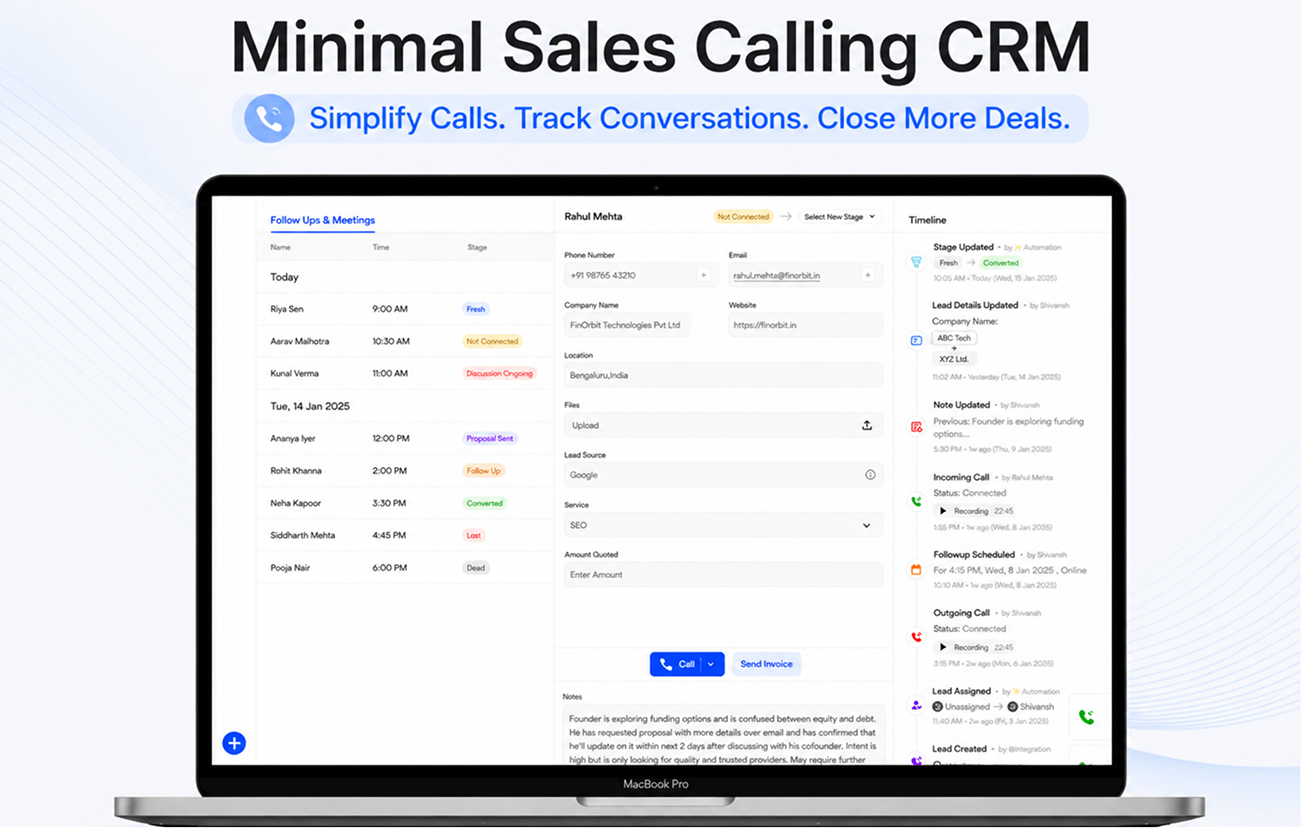
With Selling OS, an e-commerce growth platform, lead management sat alongside an ROI calculator, demo booking and analytics in one system, because splitting those across tools broke the funnel. MSR Assessment needed a CRM shaped around assessments rather than around deals. UNA-CRM and Call Louder each turned on call and follow-up mechanics that generic pipeline software treats as an afterthought.
The other consistent lesson is unglamorous: the CRM your team actually uses beats the one with more features. Adoption is a design problem, not a licensing one. We wrote about that in more detail in how strategic CRM development automates your sales pipeline.
A five-minute decision rule
- Multiply your expected seat count in three years by your plan’s annual price, times three. That is your buy cost.
- Estimate your build tier from the three bands above. Add 20 percent per year for maintenance across the same three years.
- If buy is more than 1.5 times build, custom is probably correct on cost alone.
- If the numbers are close, decide on process fit instead. Weird process means build. Standard process means buy.
- If you cannot describe your pipeline stages in one sitting, do neither yet. Fix the process first, or you will automate the confusion.
That last point matters more than the rest. A custom CRM is a mirror. If the process going in is unclear, the software coming out will be too.
If cost modelling is the part you are stuck on, our breakdown of what software actually costs to build in India in 2026 uses the same method on a bigger scope.
Talk it through
Send us your pipeline stages and your seat count and we will tell you honestly which side of the line you are on, including when the answer is to buy Zoho. Our CRM development service has the detail on how we scope these.