

Lead Scoring in CRM: 7 Rules That Sales Teams Actually Trust
Lead scoring in CRM is the practice of assigning every lead a number that predicts how likely it is to convert, so reps work the best leads first. It fails in most Indian sales teams for one reason: the score is built from marketing signals the sales floor cannot see, cannot question and cannot correct, so reps quietly ignore it.
We have built and maintained sales systems where scoring is the difference between a rep making 40 useful calls a day and 40 wasted ones. This piece covers what actually goes into a score sales teams trust, what the major platforms require before their models work, what it costs in India, and what the DPDP Rules change for anyone scoring personal data.
Why lead scoring in CRM loses the sales team
Ask a sales manager in Delhi NCR why the team ignores the score and you tend to get the same three answers.
The first is that the score never changes. A lead that downloaded a brochure in March still shows 85 in September because nothing in the model decays. Reps learn within a fortnight that a high score means “was interested once”, not “is interested now”, and they stop sorting by it.
The second is that the score is a black box. A rep gets a lead marked 92 and has no idea whether that came from job title, company size, three pricing page visits or a form fill from a personal Gmail address. When the lead turns out to be a student doing a college project, the rep has no way to feed that back. The model does not learn and the rep does not forgive.
The third, and the most damaging, is that the score is scored on the wrong outcome. Most default models optimise for conversion to a qualified lead, which is a marketing event. Sales is paid on closed revenue. A score that reliably predicts who will take a demo is not the same thing as a score that predicts who will pay, and in businesses with long sales cycles those two populations barely overlap.
None of these are model problems. They are product problems, which is why they get solved in the CRM build and not in a spreadsheet.
Rules you write versus models that learn
There are two honest approaches and one useful combination.
Rules-based scoring means a human writes the logic: plus 20 for a company email domain, plus 15 for a pincode you deliver to, minus 30 for a competitor domain, minus 10 per week of no activity. It is transparent, it works from day one with no history, and a sales head can argue with it, which is exactly the property that builds trust.
Predictive scoring means a model learns from your closed-won and closed-lost history. It finds patterns nobody wrote down. It is also useless until you have enough labelled outcomes, and it cannot explain itself in a way a rep will accept at 11am on a Tuesday.
The combination most teams end up shipping is a rules-based score that reps can see and challenge, with a model score shown alongside it as a second opinion once there is enough history to justify one.
| Approach | Works from | Explains itself | Best for | Main failure mode |
|---|---|---|---|---|
| Rules-based | Day one | Yes, fully | Teams under roughly 1,000 leads a quarter | Rules go stale, nobody owns them |
| Predictive | After 6 to 12 months of clean outcome data | No, only top factors | High-volume inbound funnels | Learns your past biases and repeats them |
| Rules plus model | Day one, model added later | Partly | Most Indian SMB and mid-market sales teams | Two numbers on screen, nobody says which wins |
What each platform needs before scoring works
This is where a lot of Indian teams get caught. Predictive scoring is sold as a checkbox and is in fact gated behind both a licence tier and a data volume you may not have.
Salesforce is explicit about it. Einstein Lead Scoring is available in Performance and Unlimited editions and at extra cost in Enterprise, and it needs at least 1,000 leads created in the last 200 days, of which at least 120 must have been converted to an account and contact. Fall short and Salesforce falls back to a global model trained on other customers’ data, which is a reasonable default and is not a model of your business.
HubSpot gates it on licence rather than volume in its public documentation: predictive lead scoring sits in Marketing Hub Enterprise and Sales Hub Enterprise. Manual score properties are available lower down the stack, which is the practical route for most teams starting out.
Zoho, which is where a large share of Indian SMBs actually live, splits it by edition too. At the time of writing, Zoho CRM’s pricing page lists Standard at ₹800, Professional at ₹1,400 and Enterprise at ₹2,400 per user per month, with predictive intelligence appearing from Professional and the wider Zia capabilities at Enterprise. Check the page before you budget, since editions and billing terms change.
The practical reading: if you have fewer than a thousand leads a quarter and no clean history of what closed, buying a predictive tier buys you a global average. Write rules instead, and collect the outcome data properly so a model has something to learn from in a year.
What lead scoring in CRM costs in India
Three cost shapes, depending on where you start.
- Configure scoring inside a CRM you already pay for. The licence uplift is the visible cost. Moving twenty users from a mid tier to a top tier at Indian list prices is usually a few lakh rupees a year in additional licence spend, before any configuration work. The hidden cost is the data cleanup, which is almost always larger than the configuration.
- Build scoring into a custom CRM. Scoring itself is a small module: a rules engine, a score history table, an override log and a display surface. It is rarely the expensive part of a CRM project. The expensive parts are the integrations feeding it, which is the same pattern we covered in our breakdown of custom CRM versus off-the-shelf for Indian SMBs.
- Bolt a scoring service onto an existing stack. Cheapest to start, worst to live with. You end up with a number computed outside the CRM that nobody can trace, which returns you to the black box problem above.
Whichever route, budget for the boring line item: someone owns the rules and reviews them every quarter. A scoring model without an owner is a scoring model that will be wrong within two quarters and ignored within three.
Seven rules for a score reps will use
Good lead scoring in CRM is less a question of algorithm choice than of these seven design decisions that decide whether the number gets used or gets scrolled past.
- Score on revenue, not on marketing milestones. Train and tune against closed-won deals. If a lead type converts to demo at a high rate and to payment at a low rate, the score must punish it, not reward it.
- Make every score clickable. Tapping the number shows the contributing factors and their weights in plain language. This single feature does more for adoption than any accuracy gain.
- Decay by default. Every behavioural signal loses value over time. A pricing page visit today and one from six weeks ago cannot carry the same weight. Set the half-life explicitly rather than letting it default to forever.
- Separate fit from intent. Fit is who they are: company size, industry, city, budget band. Intent is what they did: pages, replies, calls answered. Show two numbers, not one blended number. A perfect-fit lead with zero intent needs nurturing; a poor-fit lead with high intent needs disqualifying, and a single blended 60 hides both cases.
- Let reps override, and log it. Give the rep a control to mark a score wrong with a reason. This is a feedback channel and a training set at the same time, and it is the fastest way to find a broken rule.
- Cap the number of tiers. Hot, warm, cold, and a numeric score behind them. Nobody works a queue of 1 to 100 meaningfully. Tiers drive the work queue; the number breaks ties.
- Publish the model’s accuracy to the floor. Once a quarter, show what share of leads scored hot actually closed. If the answer is embarrassing, reps already knew. Publishing it is how you earn the right to ask them to follow it.
Where scoring meets the calling workflow
A score is only worth the workflow it feeds. Two of our builds sit on opposite ends of that idea.
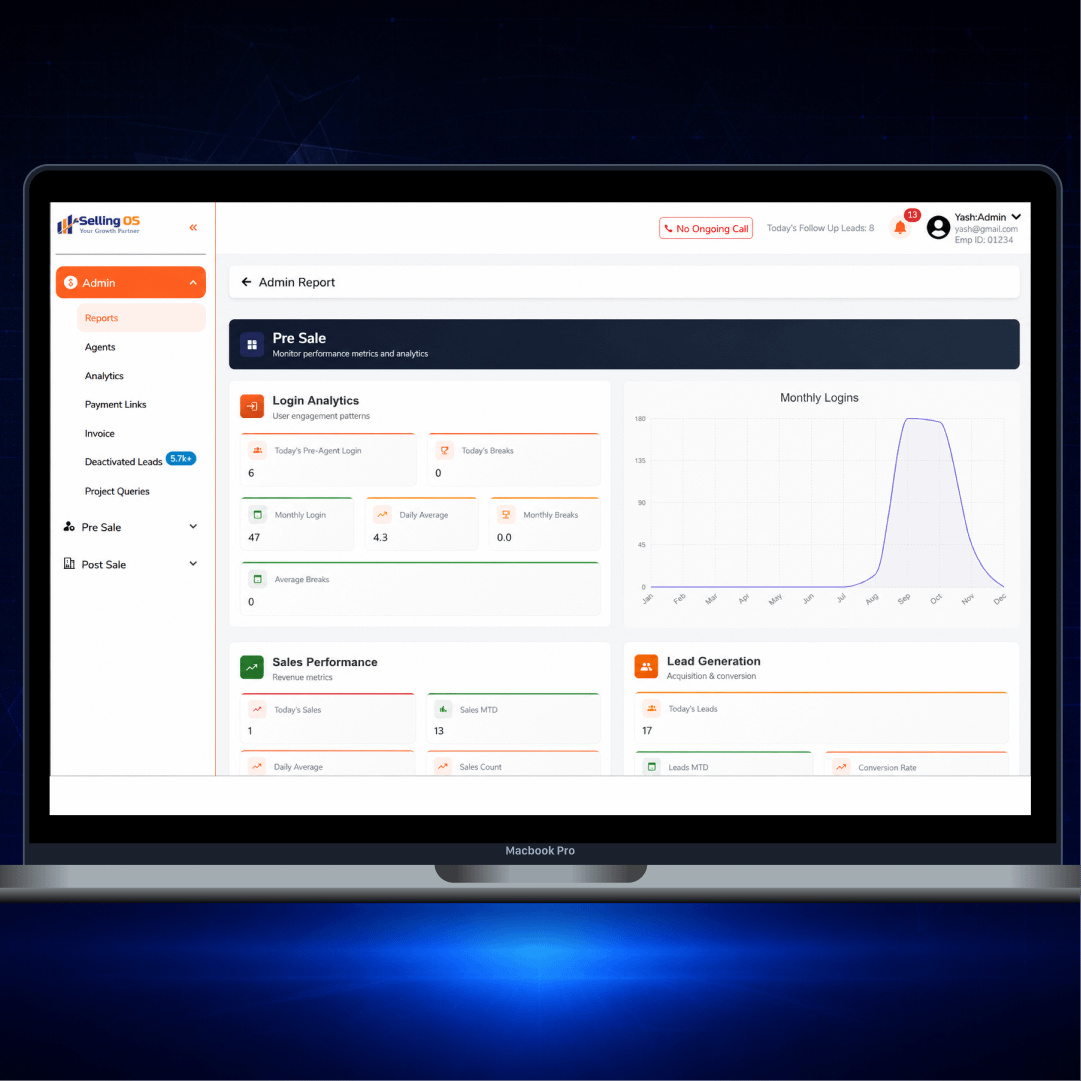
Selling OS is an ecommerce growth platform with a CRM foundation, where the lead management module sits alongside an ROI calculator, demo booking and an analytics dashboard. The lesson from that build is that scoring inputs are cheap when the same platform already owns the demo booking and the calculator interaction. When the signal and the score live in one system, you do not spend the project arguing about which tool holds the truth.
UNA-CRM goes the other way. It is a deliberately minimal calling CRM built around one lead at a time, with notes and follow-up scheduling and very little else on screen. In a single-lead interface, the score does not sit in a sortable column at all. It determines the order the leads arrive in, which is a stricter test: if the ordering is wrong, the rep feels it immediately and there is nowhere to hide.
Both patterns are valid. What matters is deciding, before you build, whether the score is advisory or whether it controls the queue. Teams that leave this ambiguous end up with a score that is technically present and functionally decorative. The same failure shows up across the whole system, which is why we wrote a separate piece on why sales teams ignore the CRM and how to fix CRM user adoption. Our wider view on making a CRM the system of record rather than a reporting chore is in how strategic CRM development automates your sales pipeline.
DPDP and scoring on personal data
Lead scoring is profiling, and profiling in India now has a statute behind it. The DPDP Rules, 2025 were notified on 14 November 2025 with an eighteen-month period for phased compliance, which means the runway is short and the clock is already running.
Three things this changes for a scoring build:
- Purpose and notice. If you collect a phone number to send a brochure and then feed call-answer behaviour into a score, the notice needs to cover that use. Retrofitting notice text after the model ships is harder than writing the model around the notice you already give.
- Erasure has to reach the score. A deletion request that clears the contact record but leaves the derived score, the score history table and the model’s training data is not a deletion. Design the score store so it can be purged with the record it describes.
- Keep the score auditable. Being able to show which inputs produced a given score is already good product design, per rule two above. It is also the only practical way to answer a question about why a person was treated the way they were.
We are not lawyers and this is not legal advice. Get your notice and consent language reviewed by counsel; the point here is that the scoring architecture has to be able to support whatever they tell you.
Build checklist before you ship a score
- Written definition of the outcome the score predicts, agreed by sales and marketing in one sentence.
- Fit and intent kept as separate stored values, blended only at display time.
- Score history table, so you can see what a lead scored last month and why.
- Explanation view on every score, in language a new rep understands.
- Decay configured per signal, with the half-life written down.
- Rep override control with a reason code, and a report on overrides.
- Quarterly review owned by a named person, with the hot-tier close rate published.
- Deletion path that removes derived scores and score history along with the contact.
- Consent notice that covers the behavioural inputs you actually use.
If you cannot tick the first, do not build the rest yet. Almost every abandoned scoring project we have seen started with a model and never had the sentence.
Getting it built
Lead scoring in CRM is a small module with an outsized effect on whether a sales team trusts its CRM at all. Done as an afterthought it becomes a number nobody reads. Designed as a product feature, with explanation, decay, overrides and an owner, it decides the order of the day’s work.
If you are planning a sales system and want the scoring designed in rather than bolted on, our CRM development services cover the rules engine, the integrations that feed it and the workflow it drives. If you are still deciding who should build it, our 12-point checklist for choosing a software development company in Delhi NCR is a reasonable place to start. Tell us what your reps are ignoring today and we will tell you whether it is a model problem or a workflow problem.
[…] CRM, ₹1,50,000 to ₹3,50,000. Pipeline stages, lead scoring your sales team will actually trust, quotations, workflow automation, […]
[…] the scoring and routing rules with the sales team, not for them. Our post on lead scoring rules sales teams actually trust covers why this is a cost item disguised as a design […]
[…] Make automation legible. When the system changes a stage or assigns a lead, show that it did and why. Opaque scoring is the fastest way to lose a sales floor, which is why the rules behind a lead score need to be inspectable by the people working the queue. […]