
Secure Deal Room Development: NDAs, Permissions and Audit Trails
Secure deal room development means building a controlled space where buyers, investors and lenders read sensitive documents under an enforceable NDA, see only what their role permits, and leave an audit trail you can produce in a dispute. In India that also means CERT-In log rules, DPDP duties and IT Act signature law.
Most teams discover they need one at the worst moment. A term sheet lands, due diligence starts, and the financials go out as a Google Drive folder with link sharing switched to “anyone with the link”. Three weeks later nobody can say who opened the cap table, whether the NDA was signed before or after the download, or why a competitor seems to know the churn number.
This post covers what we have learned building deal room and document-permission layers into Indian products, including Fundist, a founder and investor matching platform with NDA-protected deal rooms. It covers the three parts that actually matter: the NDA, the permission model, and the audit trail.
Why Indian Deal Flow Needs a Real Deal Room
The volume is the argument. In the July to September quarter of 2026, India recorded 255 M&A deals worth 13.2 billion dollars and 353 private equity transactions worth 9.9 billion dollars, according to Grant Thornton Bharat’s Q3 Dealtracker. That is roughly 600 diligence processes in a single quarter, and that count excludes the 60 IPOs and 28 QIPs in the same period.
Every one of those processes moves documents that should not leak: customer contracts, salary bands, unit economics, pending litigation, source code escrow terms. Most mid-market Indian deals still move them over email and consumer file sharing. That works until it does not, and when it fails you have no record to fall back on.
A deal room is not only an M&A tool either. The same pattern shows up in fundraising platforms, lender portals, franchise onboarding, vendor bidding and any process where outsiders need temporary, scoped access to documents you cannot afford to lose control of.
What Secure Deal Room Development Actually Involves
Teams usually scope this as “upload, share, download” and then spend the next two sprints discovering the rest. The work breaks into four layers, and only the first is about files.
- Storage and rendering. Encrypted object storage, server-side rendering so the original file never reaches the browser, dynamic watermarking per viewer, and a viewer that works on a phone because half your counterparties will open it on one.
- Identity and gating. Invite-only access, email or OTP verification, optional KYC for regulated flows, and an NDA gate that blocks the room until it is accepted.
- Permissions. Roles, groups, per-folder and per-document rules, expiry dates, and the ability to revoke in one click when a bidder drops out.
- Evidence. Immutable logs of every view, download, print and permission change, with timestamps you can defend.
The fourth layer is the one that gets cut for launch and the one you will wish you had. Build it first, because retrofitting a tamper-evident log onto a system that has been writing mutable rows for a year is a migration, not a feature.
The NDA Layer: What Holds Up in Indian Law
A click-through NDA inside your product is a real agreement in India, provided you get the mechanics right. Electronic signatures are recognised under Section 3A of the Information Technology Act, 2000, and Aadhaar eSign was added to Schedule II of that Act by a notification in January 2015. That gives you two usable tiers.
Click-wrap acceptance
A checkbox plus a recorded intent is enough for most mutual NDAs. What makes it defensible is what you store alongside it: the exact document version hash, the timestamp, the IP and user agent, and the sequence proving acceptance happened before any document was served. If your log cannot show that order, the NDA is decoration.
Aadhaar eSign or a DSC
Where the counterparty is an institution, or the document is a binding exclusivity or a share purchase agreement, use a Certifying Authority backed signature. Under the Indian Evidence provisions, a secure electronic signature carries a presumption that the signatory affixed it and that the record has not been altered since, which shifts the burden off you.
Two constraints to design around. First, Schedule I of the IT Act excludes certain instruments from electronic signature altogether, including powers of attorney, trust deeds, wills, negotiable instruments other than cheques, and contracts for the sale or conveyance of immovable property. A real estate deal room still needs wet ink on the conveyance. Second, stamp duty is a separate obligation from signature validity and varies by state, so an e-signed agreement can be valid and still be inadmissible until it is stamped. Keep a state-wise stamping step in the workflow rather than assuming eSign covers it.
Permissions: Role-Based Access at Document Level
The usual mistake is modelling permissions on folders. Deals do not work that way. A strategic buyer who is also a competitor gets the financials but not the customer list. A lender gets the debt schedule and nothing else. A bidder who drops out on day 40 must lose everything retroactively, including anything cached.
What we build instead:
- Role, group, then override. Three layers, evaluated in that order, with deny always beating allow. Four roles cover most rooms: owner, internal contributor, external reviewer, read-only observer. For the wider permission model behind this, see our guide to role-based access control.
- Per-document capability flags. View, download, print and copy are four separate rights, not one. Most external reviewers should get view only.
- Time-boxed grants. Every external grant carries an expiry. Default to 30 days and make extension an explicit action, so access dies by default instead of surviving by neglect.
- Staged disclosure. Tier documents so round-two bidders unlock a second set automatically. This is the feature deal leads ask for second and value most.
- Revocation that actually revokes. Short-lived signed URLs, no permanent links, and watermarks rendered per request so a shared screenshot still carries the viewer’s identity.
If you are designing the permission model from scratch, the trade-offs in our post on why sales teams ignore the CRM apply here too: a permission system people find unworkable gets routed around with a WhatsApp forward, and then you have no room at all.
Audit Trails That Survive a Dispute
This is where Indian regulation gets specific, and where most builds are non-compliant without realising it.
CERT-In’s directions of 28 April 2022, issued under Section 70B(6) of the IT Act, require entities to enable logs of all ICT systems and maintain them for a rolling 180 days, stored within India, and to report cyber incidents to CERT-In within six hours of noticing them. The same directions require system clocks to be synchronised to NTP sources traceable to the National Informatics Centre or the National Physical Laboratory. That last requirement is easy to miss and it is the one that decides whether your timestamps mean anything in a dispute.
On top of that, the DPDP Rules notified in November 2025 phase in over eighteen months, with the substantive obligations landing in May 2027. Those include a 72-hour detailed breach report to the Data Protection Board and a one-year log retention rule, per the government’s own summary of the Rules. Our DPDP Act compliance guide covers the wider obligations; for deal rooms the practical reading is that 180 days is the floor and one year is the number to design for.
Four properties make a deal room log usable as evidence:
- Append-only. No update or delete path, even for administrators. Corrections are new rows.
- Hash-chained. Each entry includes a hash of the previous one, so tampering is detectable rather than merely prohibited.
- Complete. Permission changes and failed access attempts are logged, not just successful views. “Who tried and was refused” is often the question that matters.
- Exportable. A signed PDF or CSV a lawyer can read without your engineers present.
Treat the log as a product feature. Deal leads will use the per-viewer activity report to judge which bidder is serious, and that is the report they will show their board.
Secure Deal Room Development Cost: Build vs Buy
If you need a room for one transaction, buy. If deal rooms are a feature of the product you sell, build. The pricing below is published market pricing, not our rates, and we have not converted it to rupees because these vendors bill in dollars.
| Option | Published pricing | Fits when | Watch out for |
|---|---|---|---|
| Flat-plan virtual data room | SecureDocs from 450 dollars a month; CapLinked around 399 dollars a month; FirmRoom 395 to 995 dollars a month by storage tier | One finite diligence window | Storage overage, which FirmRoom lists at 150 dollars per GB per month |
| Storage-tier VDR | Ansarada’s published list runs 99 dollars a month for 50 MB up to 8,579 dollars a month for 20 GB, with roughly 40 to 53 percent off on a 12-month term | You can predict data volume | Overage is measured at peak usage, so shrinking the room mid-term does not reduce the bill |
| Enterprise VDR | Intralinks annual contracts commonly 4,000 to 25,000 dollars and up; Datasite from around 25,000 dollars a year; per-page models run 0.40 to 0.85 dollars per page | Banker-led large-cap M&A | Per-page billing on a page count you cannot forecast |
| Custom build inside your product | One-time build plus hosting and maintenance | Recurring deal rooms, Indian data residency, or deal rooms as a revenue feature | You own the logging, retention and security work the vendors were doing for you |
The honest build case is narrow. It is strong when the deal room is a feature your users pay for, when CERT-In’s in-India log storage rule rules out a vendor’s region, or when the room must sit inside an existing product so permissions and identity are shared. For a single sale of your own company, a subscription is cheaper than a sprint. The same calculus we set out in staff augmentation vs fixed price applies: count the twelve-month total, not the first invoice.
Secure Deal Room Development Checklist: 7 Rules
- Gate on the NDA, in the right order. No document is served until acceptance is recorded, and the log proves acceptance came first.
- Version and hash every document. An NDA that references “the attached” is weak. One that references a hash is not.
- Make download a separate right from view. Default external reviewers to view only, with per-request watermarking.
- Expire every external grant. Thirty days, renewable by explicit action.
- Append-only, hash-chained logs from day one. Include permission changes and refused attempts.
- Store logs in India for at least 180 days, and plan for one year. Sync clocks to NIC or NPL traceable NTP.
- Ship the activity report as a feature. Per-viewer engagement is what the deal lead takes to the board.
Three Mistakes That Cost Deals
Treating revocation as a flag. Flipping a boolean while long-lived signed URLs stay valid means a revoked bidder keeps reading. Expire the URLs, not just the record.
Logging only what succeeded. The interesting event in a leak investigation is almost always a refused or unusual attempt. If you did not log it, the investigation ends at a shrug.
Assuming eSign settles stamp duty. Validity and admissibility are different questions in India, and stamp duty is state by state. Build the stamping step into the workflow or your enforceable NDA sits unenforceable in a drawer.
If you are adding a deal room, document vault or compliance-grade permission layer to an existing platform, that work usually belongs with the rest of your product rather than beside it. Our custom software development team builds these layers into live Indian products, and our KYC and AML implementation guide covers the identity side if your rooms need verified counterparties. Tell us what your deal flow looks like and we will tell you honestly whether to build it or buy a subscription.
[…] Once those counterparties are verified and need to read confidential documents, the next layer is secure deal room development, which covers NDA gating, role-based permissions and audit […]
[…] Our default for Indian B2B products is RBAC as the backbone with a few attribute checks on top, typically an approval limit in rupees and a branch or state boundary. That keeps the permission screen explainable to a non-technical admin, which matters more than people expect. For document-heavy workflows the relationship model earns its keep, as in our post on building a secure deal room with NDAs, permissions and audit trails. […]
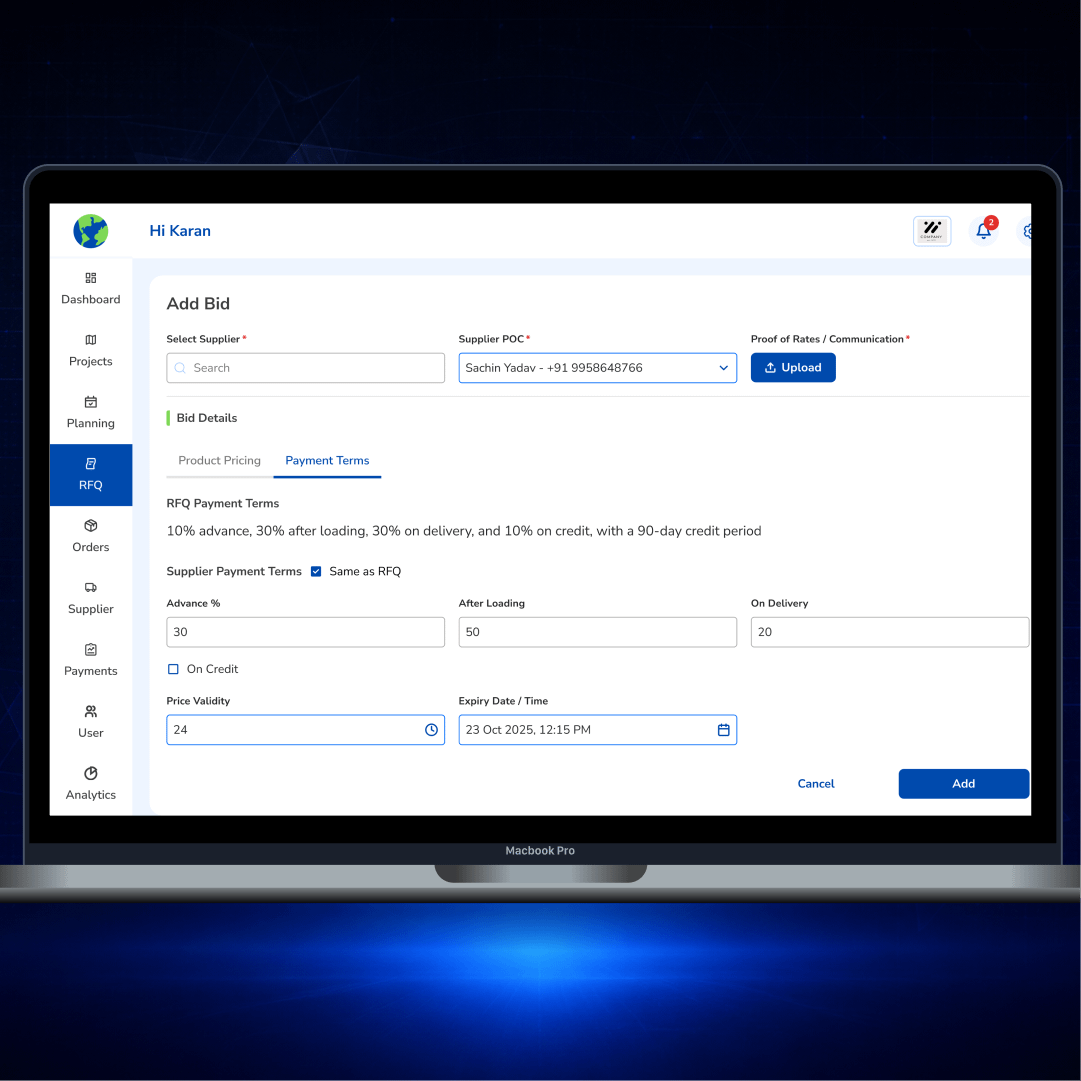
[…] The Add Bid screen carries supplier selection, document upload and a bid expiry time. Those three fields are the minimum viable bidding portal. The document upload is where the permission work lives, because a specification drawing attached to an RFQ should be visible to invited suppliers and to nobody else. We wrote about that pattern in more depth in our guide to secure deal room development. […]