
Building an Internal Bidding Portal: The Zenobid Case Study
Bidding portal development is the work of turning a procurement process that runs on phone calls, WhatsApp photos and email attachments into a single system where requirements go out as an RFQ, suppliers quote against a deadline, quotes are compared side by side, and the winning quote becomes a purchase order with an audit trail behind it.
That sounds simple until you build one. The hard parts are not the forms. They are the rules about who can see which quote and when, what happens to a bid when the clock runs out, how a purchase order ties back to the bid that produced it, and whether the record you hold would survive a dispute two years later.
We built Zenobid, a procurement platform where buyers raise requirements and suppliers bid against them, with order and payment tracking on both sides. This post uses it to walk through the decisions that actually shape a build, and the Indian compliance work that gets discovered late and budgeted never.
What an internal bidding portal actually does
An internal bidding portal sits between a requirement and a purchase order. A project team raises a request for quotation. Named suppliers receive it, see the specification and the closing time, and submit a price. The buyer compares, awards, and the system issues a PO. Everything that happened is logged.
The word “internal” matters. A public e-tendering site is open to any registered vendor. An internal portal runs on an invited panel of suppliers that the buyer has already onboarded, rated and given credit terms to. That changes the design in three ways:
- Supplier onboarding is a module, not a signup form. GSTIN, PAN, bank details, trade licences, past performance and category coverage all have to be captured and approved before a supplier can be invited to anything.
- Invitation is explicit. You pick who sees the RFQ. That list is itself a sensitive artefact, because knowing who else was invited tells a supplier a great deal about their odds.
- Price history is an asset. Over a year the portal accumulates what every supplier quoted for every item. That data is the real return on the build, and it is also the thing most likely to leak if your permission model is loose.
Bidding portal development: 7 decisions that shape the build
These seven choices account for most of the variation we see between a three month build and a nine month one. Settle them in discovery, not in sprint six.
- Who can see a bid before close. If nobody can, including the buyer, you need encryption at rest with a key that is only released at close. If the buyer can, you have a far simpler system and a far weaker story if a supplier alleges favouritism.
- What happens at expiry. Does the bid window close hard, extend when a bid lands in the final minutes, or allow a revised quote? Each option is a different state machine and a different set of notifications.
- Whether revisions are allowed. One shot per supplier is clean. Multiple rounds mean you must store and display every version, because the version a supplier remembers submitting and the one you evaluated must be the same.
- How comparison works. Lowest price is rarely the answer in practice. Landed cost, payment terms, delivery lead time and past performance all feed the decision, so the comparison view needs a weighting model the buyer can see and justify.
- Partial awards. Can one RFQ with eight line items be split across three suppliers? If yes, every downstream object (PO, shipment, invoice, payment) has to handle a partial relationship to the originating bid.
- Who approves above what value. Approval thresholds in rupees, routed by project or cost centre, with a delegation path for when the approver is on leave. This is where most portals quietly fall back to email.
- What the audit trail has to prove. Not “we log things” but specifically: who saw which price, at what time, and did anything change after close. Decide this on day one, because retrofitting an append-only log into a system that has been happily updating rows in place is a rewrite.
Inside Zenobid: what the screens tell you
Zenobid is a construction materials procurement platform. The quickest way to understand how a bidding portal is put together is to look at what the two sides of it show.
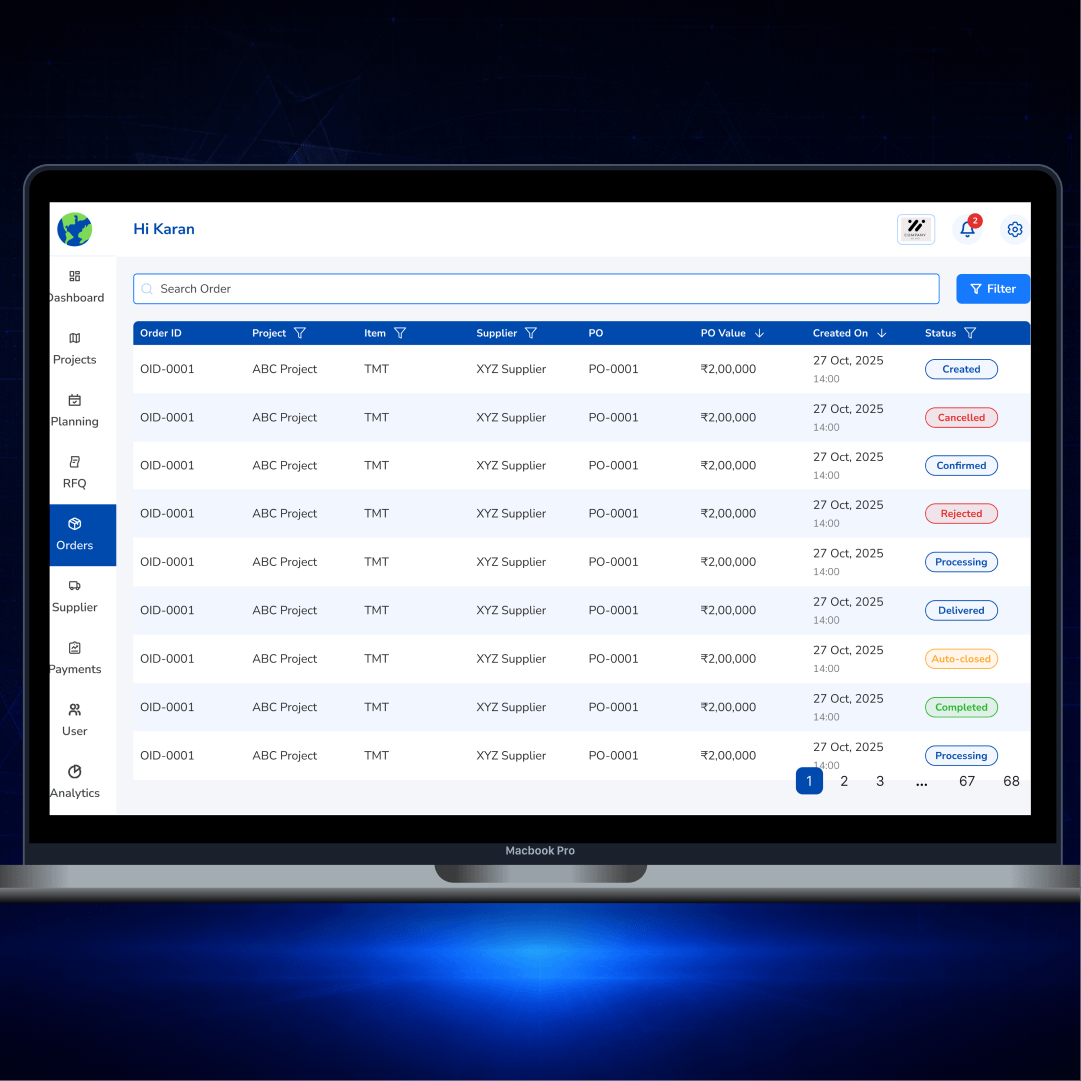
The buyer side carries Dashboard, Projects, Planning, RFQ, Orders, Supplier, Payments, Users and Analytics. The supplier side of the same product carries Dashboard, RFQ, Bids, Orders, Transactions, Users and Analytics. Note what is missing on the supplier side: there is no Supplier module and no Projects module, because a supplier has no business seeing the buyer’s vendor panel or project structure. That is a role model expressed as navigation, which is the only version of access control that users actually notice.
Three things in those screens are worth copying.
Order status is a real state machine
Zenobid’s order list carries statuses including Created, Confirmed, Rejected, Processing, Delivered, Cancelled, Auto-closed and Completed. Auto-closed is the interesting one. It is the status that exists because somebody asked what happens to an order nobody responds to, and the answer was not “it sits in the list forever”. Every portal needs that answer. Shipments carry their own separate track: Created, Delivered, Received, Returned, Cancelled, Payment Done.
Bids have an expiry, suppliers are selected, documents are attached
The Add Bid screen carries supplier selection, document upload and a bid expiry time. Those three fields are the minimum viable bidding portal. The document upload is where the permission work lives, because a specification drawing attached to an RFQ should be visible to invited suppliers and to nobody else. We wrote about that pattern in more depth in our guide to secure deal room development.
Payments reconcile against the UTR, not against a screenshot
The transactions view keys each payment to a UTR number, with payment type and date, and rolls up to Order Value, Total Receivable, Received and Remaining on the supplier’s order. The Unique Transaction Reference is the number the bank issues for a NEFT, RTGS or IMPS transfer, so it is the one identifier both sides can check independently. Build reconciliation around it from the start. Teams that start with “supplier uploads a payment screenshot” spend the next year unwinding that decision.
Sealed bid, open bid or reverse auction
Most buyers assume they want a reverse auction because it sounds like it extracts the lowest price. In practice the format should follow the category.
| Format | How it works | Best for | Build complexity | Main risk |
|---|---|---|---|---|
| Sealed bid | Quotes are hidden until the close time, then opened together | Specified goods, one-off works, anything where fairness must be demonstrable | Medium. Needs encryption at rest and a controlled open event | Thin participation if suppliers cannot gauge the market |
| Open bid | Suppliers see the current best price and can better it | Commodity items with many interchangeable suppliers | Low to medium | Price signalling and collusion between a small supplier set |
| Reverse auction | Live timed event, price falls as suppliers undercut each other | High volume standardised materials with a deep supplier panel | High. Needs real time infrastructure, anti-sniping rules and tie-break logic | Quality and delivery get squeezed out of the decision |
| Negotiated | Shortlist from quotes, then a direct conversation | Services, custom fabrication, low volume high value | Low. Mostly workflow and notes | Hardest to audit, most dependent on the buyer’s judgement |
A useful rule: if you cannot write the specification tightly enough that two suppliers would deliver the same thing, a reverse auction will hurt you. Start with sealed bid, add other formats once you have a year of price history to tell you which categories are genuinely commoditised.
The Indian compliance layer you cannot skip
Four things land on an Indian bidding portal. None of them are optional, and all of them are cheaper to build in than to bolt on.
Audit logs that work as evidence
The Bharatiya Sakshya Adhiniyam 2023 replaced the Indian Evidence Act and came into force on 1 July 2024. Where an electronic record is produced without the device itself, Section 63 requires a certificate identifying the record and the device that produced it, signed by the person in charge of the system and by an expert. The practical consequence for a bidding portal is that a log is only useful if its integrity can be demonstrated, so write logs append-only, timestamp from a single authoritative clock rather than the client, and hash records at the point of export. A log that any admin can edit is not an audit trail, whatever the feature list calls it.
GST and e-invoicing
Purchase orders do not need an IRN, but the tax invoices your suppliers raise against them often do. E-invoicing applies to businesses with aggregate annual turnover above Rs 5 crore, and taxpayers with turnover of Rs 10 crore and above have had a 30 day limit for reporting documents to the Invoice Registration Portal since 1 April 2025. Your portal should therefore store the supplier’s GSTIN, validate it at onboarding, carry HSN codes on line items, and have somewhere to record the IRN and the signed QR code against the invoice. Doing this later means a data migration across every historical order.
Personal data under the DPDP regime
Supplier contact names, phone numbers, driver details and KYC documents are personal data. The Government notified the Digital Personal Data Protection Rules, 2025 on 14 November 2025 with an eighteen month phased compliance timeline, according to the Press Information Bureau. Requests from individuals to access, correct, update or erase their data have to be answered within a maximum of ninety days. For a procurement portal that means three concrete features: a consent notice at supplier onboarding, a retention rule for bid documents once an RFQ is closed, and an export and delete path for a contact person who leaves a supplier. We covered the wider obligations in our post on DPDP Act compliance for Indian app owners.
If you also sell to government
Private buyers are not bound by the General Financial Rules, but any supplier on your panel that also sells to the public sector is operating under them, and matching the vocabulary makes adoption easier. The Department of Expenditure’s Manual for Procurement of Goods, 2024 records that it is mandatory for Central Ministries and Departments, CPSEs and autonomous and statutory bodies to publish all tender enquiries and resulting contract information on the Central Public Procurement Portal, and that end to end e-procurement is mandatory for all procurements. It also notes that common use goods and services available on the Government e Marketplace must be procured through GeM under Rule 149 of GFR 2017. If your roadmap includes public sector buyers, look at how the CPPP structures tender stages before you invent your own.
What drives bidding portal development cost
We will not quote our own rates here, but we can be specific about what moves the number. In our experience the variance between two bidding portal development quotes almost always comes from these five items rather than from the base CRUD:
- Sealed bid encryption. Hiding prices from the buyer until close, with key management and a controlled open event, is a distinct piece of engineering. Visible-to-buyer quotes are far cheaper.
- Real time. A static bid window needs nothing special. A live reverse auction needs websockets, a server authoritative clock, anti-sniping extensions and load testing against the worst case of forty suppliers bidding in the final ten seconds.
- ERP and Tally integration. If POs and invoices have to flow into an existing accounting system, the integration is often larger than the portal module it feeds.
- Permission depth. Two roles is a week. Project-scoped, value-banded approval chains with delegation are a multi sprint subsystem. Our note on getting role-based access control right the first time explains why this is the one thing not to defer.
- Supplier mobile app. Suppliers who quote from a site office will not use a desktop portal. A supplier-side mobile app roughly adds a second product to the scope.
One more cost that rarely appears in a quote: supplier onboarding. The portal is worthless until forty suppliers are actually in it with verified GSTINs and bank details. Budget time and a person for that, not just code.
A build sequence that works
- Supplier master and roles first. Onboarding, verification, categories and the permission model. Nothing downstream is correct if this is wrong.
- RFQ and sealed bid, single round. Create a requirement, invite suppliers, accept one quote each, close at a fixed time.
- Comparison and award. The side by side view with whatever weighting the buying team actually uses today, even if it is crude.
- PO generation. The award becomes a document, with the bid it came from linked permanently.
- Delivery and shipment tracking. Separate status track, as Zenobid does, because goods and paperwork move at different speeds.
- Payments and reconciliation. UTR keyed, with receivable and remaining balances per order.
- Analytics. Price history per item per supplier. This is the module that justifies the whole build to the finance team, and it needs the six months of data that the earlier steps produce.
Reverse auctions, multi-round bidding and ERP sync come after that, informed by what the first six months of real data tells you. Teams that start at step seven build a beautiful auction engine that nobody has suppliers for.
Procurement is also only one half of the picture. If you are building for the construction sector specifically, our analysis of why material buying in India is still broken covers the demand side that a bidding portal plugs into.
Planning a bidding portal
If you are scoping an internal bidding or e-procurement portal and want a straight assessment of what it will take, our custom software development team in New Delhi can work through the seven decisions above with you and come back with a scoped build plan. Send us what you buy, who you buy it from and how approvals run today, and we will tell you honestly what the portal needs to do and what it does not.
[…] Where the buying side runs on quotes rather than listed prices, the same problem is solved with an internal bidding portal, which we break down through the Zenobid build. For the mechanics of the build itself, including inventory sync, GST invoicing and delivery, see […]