

Shopify vs Custom Build for Indian D2C Brands: The 2026 Numbers
Shopify vs custom build is rarely a cost decision for Indian D2C brands, and the arithmetic says so. Shopify’s plan fees plus its third-party gateway charge stay under ₹20 lakh a year even at ₹25 crore GMV. A custom build earns its keep only when Shopify structurally cannot model your catalogue, pricing or fulfilment.
That conclusion annoys a lot of development agencies, including ones that would happily quote you for a storefront. But we have built both, and the honest version is that most Indian D2C brands are paying a platform fee that is cheaper than the engineering it would replace. The interesting question is not which costs less. It is which constraints you are willing to live inside.
There are 129,730 live Shopify stores in India as of October 2026, according to the Storeleads India report, down about 1 percent quarter on quarter and up 3 percent year on year. That is a mature market, not a land grab. The brands leaving Shopify are mostly leaving for a reason that has nothing to do with the monthly bill.
Shopify vs custom build: the short answer
Stay on Shopify if your business looks like this: a single-brand catalogue of physical goods, one or two warehouses, standard prepaid and COD checkout, discounts that fit a coupon engine, and a product page that is images, variants and a price.
Build custom if any one of these is true: you are a marketplace with multiple sellers settling separately, your pricing depends on customer, quantity or contract, your inventory lives across suppliers you do not control, your product is configured rather than picked, or your checkout has to do something a hosted checkout will not let you touch.
Notice that none of those triggers is cost. They are all shape-of-business problems. If you are choosing on price alone, Shopify wins for almost every Indian D2C brand under a few hundred crore in GMV.
What Shopify actually costs an Indian store in 2026
Shopify publishes rupee pricing for India. These are the figures on the official Shopify India pricing page as of October 2026.
| Plan | Monthly billing | Annual billing (per month) | Third-party gateway fee |
|---|---|---|---|
| Basic | ₹1,994 | ₹1,499 | 2.0% |
| Grow | ₹7,447 | ₹5,599 | 1.0% |
| Advanced | ₹30,164 | ₹22,680 | 0.6% |
| Plus | From ₹1,75,000 | Not published | 0.2% |
Two line items catch people out. POS Pro is ₹7,000 per month per location on Basic, Grow and Advanced, which matters the moment a D2C brand opens a kiosk or does exhibitions. And marketplace sync is free for the first 50 synced orders a month, after which Shopify charges 1 percent of those orders, capped at 99 US dollars a month, on every plan. If you are pushing SKUs to Amazon and Flipkart from Shopify, budget for that cap.
The gateway fee most Indian brands miss
Here is the part that gets skipped in most comparisons. Shopify Payments, the in-house processor that lets merchants avoid Shopify’s percentage cut, is available in 40 countries and regions, and India is not one of them.
So an Indian store always runs a third-party gateway, and always pays Shopify’s third-party provider fee on top of what the gateway charges. You are paying twice on every order.
On the gateway side, Razorpay’s published standard pricing is a 2 percent platform fee plus GST on successful payments. UPI carries zero MDR under the government’s policy, but Razorpay states that the 2 percent platform fee still applies. Credit card on UPI is listed at 2.15 percent plus GST. Funded startups can ask for custom pricing, and there is a 90-day free period for new accounts.
Stack those and a brand on Shopify Basic is paying roughly 4 percent of GMV in payment-related fees before GST, not the 2 percent they budgeted. That single misunderstanding is the most common reason a founder calls us believing they need to leave Shopify. Usually the right fix is moving up a plan, not rebuilding.
Total platform cost at four GMV levels
This table takes annual billing and adds only Shopify’s own third-party gateway fee. It deliberately excludes the gateway’s MDR, apps and GST, because those apply to a custom build too.
| Annual GMV | Basic | Grow | Advanced | Plus |
|---|---|---|---|---|
| ₹50 lakh | ₹1,17,988 | ₹1,17,188 | ₹3,02,160 | Not viable |
| ₹2 crore | ₹4,17,988 | ₹2,67,188 | ₹3,92,160 | ₹21,40,000 |
| ₹5 crore | ₹10,17,988 | ₹5,67,188 | ₹5,72,160 | ₹22,00,000 |
| ₹25 crore | ₹50,17,988 | ₹25,67,188 | ₹17,72,160 | ₹26,00,000 |
Read the ₹25 crore row carefully. The entire Shopify bill, plan plus percentage, is ₹17.7 lakh a year on Advanced. That is the number a custom build has to beat, and it has to beat it while also absorbing hosting, monitoring, security patching and the engineering time to keep a checkout working through every gateway and courier API change.
Three crossover points worth knowing
Because the plan fee is fixed and the gateway fee is a percentage, each upgrade has a clean breakeven. Using annual billing:
- Basic to Grow at about ₹49 lakh annual GMV. The plan costs ₹49,200 more per year and saves 1 percent of GMV. Below ₹49 lakh, stay on Basic.
- Grow to Advanced at about ₹5.1 crore annual GMV. The plan costs ₹2,04,972 more and saves 0.4 percent. This is why the ₹5 crore row above is almost a dead heat.
- Advanced to Plus at about ₹45.7 crore annual GMV on fee arithmetic alone. In practice brands move to Plus earlier, for checkout scripting, B2B and multi-store, not to save on the percentage.
If you take one operational action from this post, it is to check which side of ₹49 lakh and ₹5.1 crore you are on. Most brands we talk to are on the wrong plan for their GMV.
What a custom build costs, and what it buys
We will not publish a headline price here, because a storefront with three couriers and a loyalty programme is not the same project as a storefront with one courier and none. What we can give you is the rate band to do your own arithmetic.
The Accelerance 2026 Global Software Development Rates and Trends Guide puts Asia at 24 to 31 US dollars an hour for junior developers and 31 to 41 US dollars an hour for senior developers, with South Asia the price leader inside that band. Convert at whatever the rupee is doing on the day and the conclusion holds: the ₹17.7 lakh a year that Shopify costs at ₹25 crore GMV buys a few hundred senior engineering hours. That is a feature, not a platform.
Which means the custom build case is never “we will save the Shopify fee”. It is “the thing we need to sell cannot be modelled in Shopify’s data structures, and the workarounds are costing us more than the build would”. Our e-commerce development engagements that made sense all started from that second sentence. If you want the stage-by-stage view of what a ground-up product costs before it earns anything, our breakdown of MVP development cost in India covers the same arithmetic for a first release.
Five things that genuinely force a custom build
- Multiple sellers with separate settlement. The moment two parties need to get paid out of one order, you are running a marketplace, and Shopify’s order model fights you. We wrote up the architecture for this in building a two-sided marketplace.
- Pricing that depends on who is asking. Contract rates, slab pricing, quantity breaks per customer, negotiated freight. Shopify B2B handles some of this on Plus. If your rules are richer than price lists and catalogues, they will not fit.
- Inventory you do not own. Stock sitting with suppliers, updating on their schedule, with your availability promise depending on theirs. The failure modes here are specific and ugly, and we covered them in real-time inventory sync across multiple suppliers.
- Configured products rather than picked ones. Made to measure, engraved, assembled from components, priced from a formula. Variants are a combinatorial dead end past a few dimensions.
- Checkout that has to do something unusual. Partial payments, deposits against made-to-order, split tender, verification before capture. Hosted checkout is the hardest part of Shopify to bend.
Notice what is not on the list: design, speed, SEO, a mobile app, custom reporting. Every one of those is achievable on Shopify, and we have seen brands rebuild for them and regret it.
GST e-invoicing and the DPDP Rules
Two Indian regulatory facts belong in this decision, and neither usually changes the answer. They change the work.
GST e-invoicing. The aggregate turnover threshold has been ₹5 crore since 1 August 2023, set by Notification No. 10/2023 Central Tax and confirmed in EY India’s alert at the time. The e-invoice portal’s own notification list records the earlier steps: ₹100 crore from January 2021, ₹20 crore from April 2022, ₹10 crore from October 2022. The direction of travel is clear. If you cross ₹5 crore, every B2B invoice needs an IRN. Indian Shopify stores above the threshold typically handle this with an app or an accounting integration rather than inside Shopify’s own invoicing, and that integration becomes a dependency you do not control. On a custom build it is a server-side job you own.
The DPDP Rules. The Digital Personal Data Protection Rules, 2025 were notified on 14 November 2025 with an eighteen-month phased compliance period, putting the main deadline in mid-2027. Data fiduciaries must answer access, correction, updating and erasure requests within ninety days.
For a D2C brand, erasure is the hard one. A customer’s data is not only in Shopify. It is in your email tool, your WhatsApp tool, your courier’s system, your reviews app and your analytics. On Shopify you depend on each app honouring its own deletion hooks. On a custom build you own the delete path and can prove it ran. That is a real argument for custom, and it is the one we hear least often.
Zavieri and Moosie: two catalogues, two answers
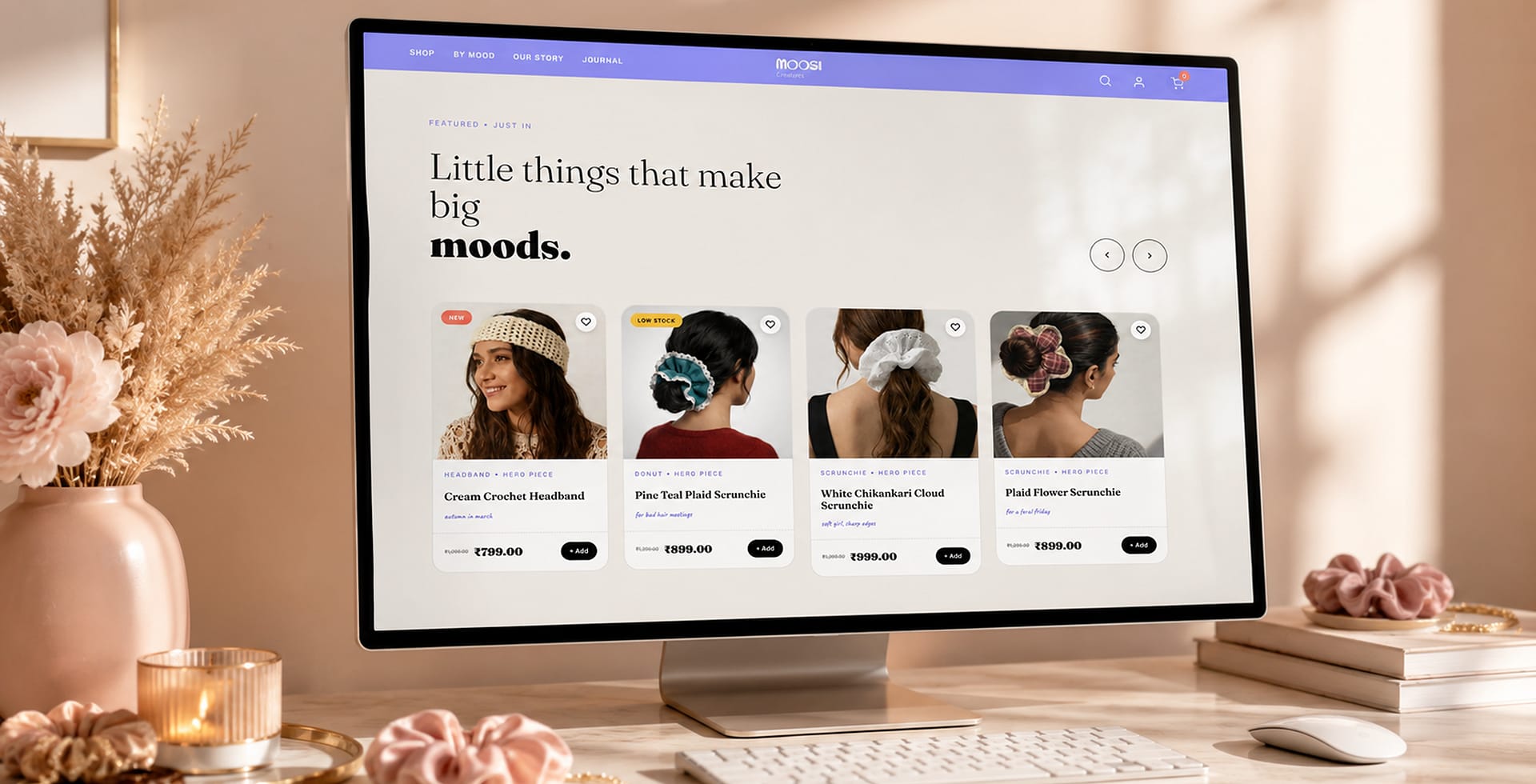
Moosie sells handcrafted hair accessories, silk and crocheted scrunchies and headbands made in small batches by rural women artisans. The live store runs on Shopify. Looking at the catalogue tells you why that is correct: price points between ₹499 and ₹999, free shipping above ₹499, a few dozen SKUs, one fulfilment path, and a product page whose job is to show the piece well. The brand’s differentiators, including silk tested by the Textiles Committee under the Government of India, are content problems, not platform problems. Spending engineering budget there instead of on photography and performance marketing would have been a mistake.
Zavieri sits in fine jewellery, and jewellery is where the question gets harder. Not because of volume, but because of what a jewellery catalogue has to carry: certification and hallmarking data, metal and stone weights that drive price, made-to-order and resizing paths, high average order values that justify assisted selling, and a return policy that is nothing like a scrunchie’s. None of that is impossible on a hosted platform. All of it is friction, and the friction compounds with catalogue size.
The pattern across both: the platform decision follows the catalogue, not the revenue.
Shopify vs custom build: a decision checklist
Run these in order. Stop at the first yes.
- Do multiple parties get paid out of a single order? If yes, build.
- Does the price of an item depend on which logged-in customer is viewing it, beyond simple tiers? If yes, build or move to Plus with B2B.
- Is your stock position a function of suppliers’ systems rather than your own warehouse? If yes, build the inventory layer at minimum.
- Is the product configured at the point of sale? If yes, build.
- Does checkout need behaviour the hosted checkout forbids? If yes, build or Plus.
- None of the above? Stay on Shopify, check you are on the right plan against the ₹49 lakh and ₹5.1 crore crossovers, and spend the saved budget on the catalogue.
One more note on migration cost, since it never appears in these comparisons. Leaving Shopify means rebuilding not just the storefront but every integration hanging off it, and running both for a period. Budget for that honestly before you decide the fee is too high.
If you are weighing Shopify vs custom build right now and want a straight answer rather than a pitch, send us your catalogue structure, your current GMV and the one thing the platform will not let you do. We will tell you which of the six checklist answers you are, and if the answer is “stay on Shopify”, we will say that. Talk to our e-commerce development team.
[…] We covered how this plays out in a materials catalogue in our guide to building a construction materials marketplace. Consumer brands hit the same wall on a hosted platform, which we unpack in Shopify vs custom build for Indian D2C brands. […]