
Home Services App Development: The HouseBanao and Hozo Playbook
Home services app development means building four connected products, not one: a customer booking app, a provider app, an admin panel with job routing, and a payments and compliance layer. In India that layer now includes GST collection under Section 9(5), e-Shram gig worker registration and DPDP consent, so plan for it from day one.
We built the apps behind two very different home services businesses in Delhi NCR. HouseBanao covers home interiors, maintenance and furniture. Hozo Homes serves corporate tenants, expats and relocated professionals with housing plus laundry, housekeeping and maintenance. Same category on the app store, very different operating models. This playbook covers what both products taught us about scope, booking design, routing, payments and the regulations Indian founders tend to discover late.
Two products, two operating models
It helps to start with what each product actually does, because the operating model decides the architecture far more than the category label does.
HouseBanao: interiors, maintenance and decor in one app
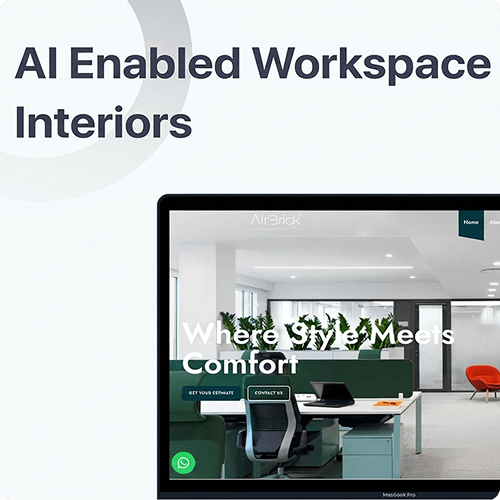
HouseBanao’s Android app describes itself as an all-in-one app for home interiors, services, furniture and decor. It combines three businesses: custom interiors (modular kitchens, wardrobes, furniture, from design consultation to execution), home maintenance (deep cleaning, pest control, appliance repair by verified professionals) and a furniture and decor shop with home delivery. The app includes project tracking, detailed quotes, order tracking and a design inspiration gallery. The scope we delivered covered product consultation, the customer app for Android and iOS, and the web presence, with features such as instant quotes, slot booking, live tracking, contractor onboarding, secure payments and multilingual support.
The key point: a pest control visit and a modular kitchen are both “home services”, but one is a small job finished in an afternoon and the other is a multi-week project with drawings, milestones and material purchases. One app has to handle both without confusing the user.
Hozo Homes: housing plus recurring services
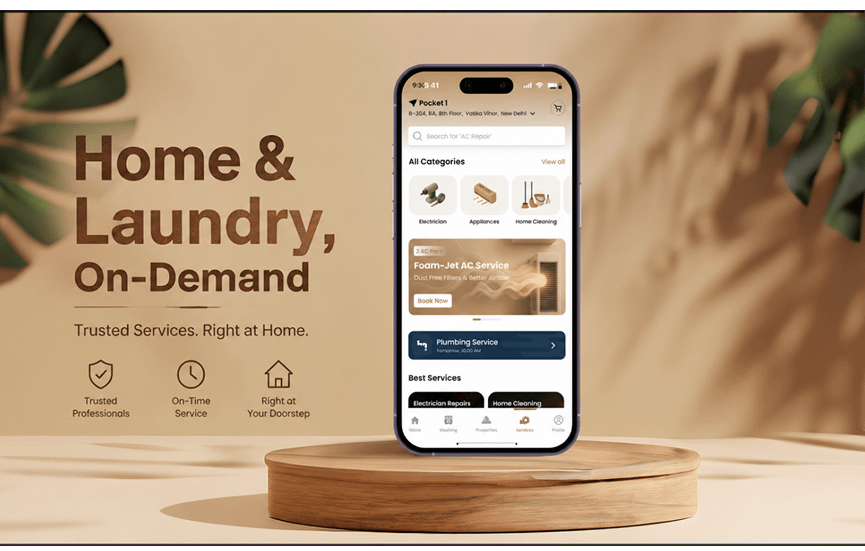
Hozo, published by Hozo Home Solutions Private Limited in Gurugram, aggregates serviced apartments, guest houses, villas and rental homes for corporates, MNCs, expats and diplomats, then layers furniture, appliances, maintenance, laundry and housekeeping on top. For Hozo we built product consultation, the customer app on Android and iOS, a web admin panel and the company website. The platform covers instant booking, real-time tracking, secure payments, subscriptions, provider onboarding, automated job routing, multilingual support, CRM and analytics. You can see the screens in our Hozo Homes home services booking app case study.
Hozo’s customer is often a tenant living in a property the platform manages. That turns services from one-off purchases into subscriptions tied to a residence, which changes billing, scheduling and support.
The four apps inside home services app development
Founders usually brief us on the customer app. The customer app is the smallest part of the system. Every serious home services product needs the four pieces below, and budgets that cover only the first one run out halfway through.
| Component | What it must do | Where it showed up in our builds |
|---|---|---|
| Customer app (Android and iOS) | Browse services, get a price or quote, pick a slot, pay, track the job, rate the provider, raise a complaint | Both products; HouseBanao adds quotes and project tracking, Hozo adds subscriptions tied to a residence |
| Provider or partner app | Accept or decline jobs, navigate to the address, update job status, upload before and after photos, see earnings and payouts | Contractor onboarding on HouseBanao; provider onboarding and job routing on Hozo |
| Admin panel (web) | Service catalogue, pricing by city or pincode, dispatch overrides, refunds, provider verification, disputes, reports | Hozo’s web admin panel with CRM and analytics |
| Payments and compliance layer | Collect money, split commission, pay providers, issue GST invoices, register workers, record consent | Secure payments on both; the compliance side has grown heavier in 2026 |
If you are deciding between a single cross-platform codebase and native apps for the customer and provider sides, our Flutter vs React Native vs native comparison for 2026 covers the trade-offs we weigh on each project.
Instant booking vs quote-first booking
The single biggest design decision is how a customer gets from “I need this” to “this is booked”. There are two patterns, and HouseBanao needs both.
| Question | Instant booking | Quote-first booking |
|---|---|---|
| Typical services | Deep cleaning, pest control, appliance repair, laundry pickup | Interiors, modular kitchens, renovation, packers and movers |
| Price shown upfront | Yes, fixed or from a rate card | No, a site visit or survey produces a quote |
| Payment | Full amount at booking or on completion | Advance plus milestone payments |
| Scheduling | Slot picker with live provider availability | Visit booking, then a project timeline |
| Main data object | Booking | Project with quotes, revisions, milestones and orders |
| Main failure mode | No provider available for the slot the customer picked | Quote revisions and scope changes that are not recorded |
The mistake is forcing one model onto the other. A slot picker for a modular kitchen annoys customers who need a designer visit first. A quote workflow for a routine AC service kills conversion. Model them as two flows that share a customer profile, address book, wallet and support system, and let each service in the catalogue declare which flow it uses.
Subscriptions are a third pattern
Hozo’s recurring housekeeping and laundry do not fit either flow cleanly. A subscription needs a schedule generator, pause and skip rules, proration when someone moves out mid-month, and a clear link to the property the tenant lives in. Treat subscriptions as their own module rather than as a booking that repeats.
Job routing and provider onboarding
Routing decides which provider gets which job. The simple version sends every new job to every nearby provider and lets the fastest one tap accept. It works until you have enough providers that the same few people grab everything and the rest leave.
A more durable routing design scores eligible providers on a few inputs:
- Skill match. A provider verified for AC repair should not receive a plumbing job.
- Service area. Pincode or polygon coverage, plus travel time rather than straight-line distance in NCR traffic.
- Availability. Declared working hours, current jobs and buffer time between jobs.
- Quality. Ratings, cancellation rate and complaint history, weighted so one bad review does not bury a new provider.
- Fairness. A cap or rotation so work is spread across the pool.
Offer the job to the top-ranked provider with a short acceptance window, then cascade. Always give operations staff a manual override in the admin panel, because a system that cannot be overruled on a bad day will be worked around on WhatsApp.
Onboarding needs as much care as routing. Collect identity documents, skill categories, service area and bank details for payouts; verify them; and keep a status history so you can show when and why a provider was approved or suspended. This is also where the 2026 labour rules, covered below, reach into your product.
Home services are a two-sided marketplace problem at heart. We wrote about balancing supply and demand in building a two-sided marketplace, and most of those lessons apply here.
Payments, commissions and GST
Money flows three ways in a home services app: the customer pays, the platform keeps a commission, and the provider receives a payout. Build this as a ledger with explicit entries for each, not as a single “amount” field on the booking.
Payment gateway costs
Razorpay’s published pricing lists a standard platform fee of 2% plus GST on successful transactions, with custom pricing for higher volumes. For a low-ticket service that is a real slice of your margin, so decide early whether you absorb it, pass it on, or nudge customers toward cheaper payment methods.
Commission levels
Commission is a business decision, but it has a product consequence: providers will see it in the earnings screen. For reference, Urban Company was reported in 2021 to have cut its commission cap to 25% from 35% after partner protests. Show providers a clear breakdown of job value, commission, and any penalties or incentives. Opaque earnings screens are one of the fastest ways to lose supply.
GST under Section 9(5)
Housekeeping services such as plumbing and carpentry supplied through an e-commerce operator have been notified under Section 9(5) of the CGST Act since 2017. In practice, as TaxTMI’s analysis of Section 9(5) explains, the platform pays the GST on these services unless the provider is liable to register under Section 22(1). Your invoicing logic therefore has to know, per provider, whether they are registered, and generate the right invoice from the right party. Retrofitting this after launch means reissuing invoices, so confirm the treatment with your CA before you build the checkout.
The 2026 gig worker rules and your provider app
The Social Security (Central) Rules, 2026 were notified on 8 May 2026, completing the rules for the Code on Social Security, 2020. According to DLA Piper’s summary, aggregators had to onboard and integrate with the e-Shram portal by 21 June 2026 and submit details of the gig and platform workers engaged through them within 45 days. New workers must be registered in real time or daily.
Three further points matter for product design:
- Eligibility is counted in days. Workers qualify for benefits after at least 90 days with one aggregator, or 120 days across several, in the previous financial year, as MediaNama reported. Your provider records should capture days engaged accurately.
- Contributions are tied to turnover and payouts. The Code sets aggregator contributions at 1% to 2% of annual turnover, capped at 5% of amounts paid or payable to gig and platform workers. Your ledger should report total payouts to workers cleanly.
- Registration is an API job. Real-time or daily registration means onboarding should trigger an integration call, not a monthly spreadsheet upload.
Whether a particular home services model counts as an aggregator is a legal question for your counsel. The engineering takeaway is simpler: build onboarding, days-worked tracking and payout reporting so you can comply without a rebuild if it applies to you.
DPDP: the data a home services app holds
Few apps know as much about a household as a home services app: full address, phone number, when the home is empty, photos of rooms, sometimes gate codes, plus identity and bank documents for every provider. The Digital Personal Data Protection Rules, 2025 were notified on 13 November 2025, and core obligations for data fiduciaries apply from May 2027, 18 months after notification.
Design choices that make compliance easier:
- Mask customer phone numbers from providers and route calls through a proxy number.
- Show a provider the full address only after they accept the job, and hide it once the job closes.
- Store before and after photos with retention rules, not forever.
- Keep provider KYC documents separate from operational data, with tighter access.
- Record consent with a timestamp and purpose, and give customers a way to withdraw it and delete their account.
Both HouseBanao and Hozo needed multilingual support too. For providers in particular, the app has to work for people who are more comfortable in Hindi than English, so consent text and job instructions should be translated properly, not just the menu labels.
Home services app development cost drivers
We do not publish a single price because two home services app development projects with the same feature list can differ several times over in effort. These are the factors that move the budget most:
- Number of booking flows. Instant booking alone is far simpler than instant plus quote-first plus subscriptions.
- Routing logic. Broadcast-to-all is cheap; scored, cascading assignment with manual override takes longer to build and tune.
- Payments. Collecting money is easy; split settlement, provider payouts, refunds and GST invoicing are where time goes.
- Provider app depth. Navigation, photo uploads, offline handling and earnings reports each add work.
- Compliance integrations. e-Shram registration, consent management and audit trails.
- Languages and cities. Each language and each city-level price list adds content and testing.
For current market price ranges by app complexity, see our guide to mobile app development cost in India.
If your service is interiors rather than repairs, the module list changes but the sequencing logic does not. We set that out in our guide to interior design app development.
A 10-point build checklist
Before you brief a development team, have answers to these:
- Which services are instant booking, which are quote-first, and which are subscriptions?
- Which cities and pincodes will you launch in, and how does pricing vary between them?
- How will providers be verified, and who approves them?
- What rules decide which provider gets a job, and who can override them?
- What commission will you take, and how will providers see it?
- Who issues the GST invoice for each service type, and how do you handle registered and unregistered providers?
- How will you register providers on e-Shram and track days engaged?
- What customer data will providers see, and when does their access end?
- Which languages do customers and providers need at launch?
- What does the operations team need in the admin panel on day one?
Teams that answer these before design starts avoid most of the expensive rework we see in this category.
Planning a home services platform?
If you are building a home services product, from a single-city cleaning service to a multi-vertical platform like HouseBanao or Hozo, our mobile app development team can help you scope the customer app, provider app, admin panel and compliance layer together. Book a free product consultation and bring your answers to the checklist above.
[…] home services and commerce. If your marketplace matches customers with service professionals, our home services app development playbook covers booking flows, job routing and the 2026 compliance layer. See our custom software […]