

Compliance Portal Development: CIN, DIN and GST Verification at Scale
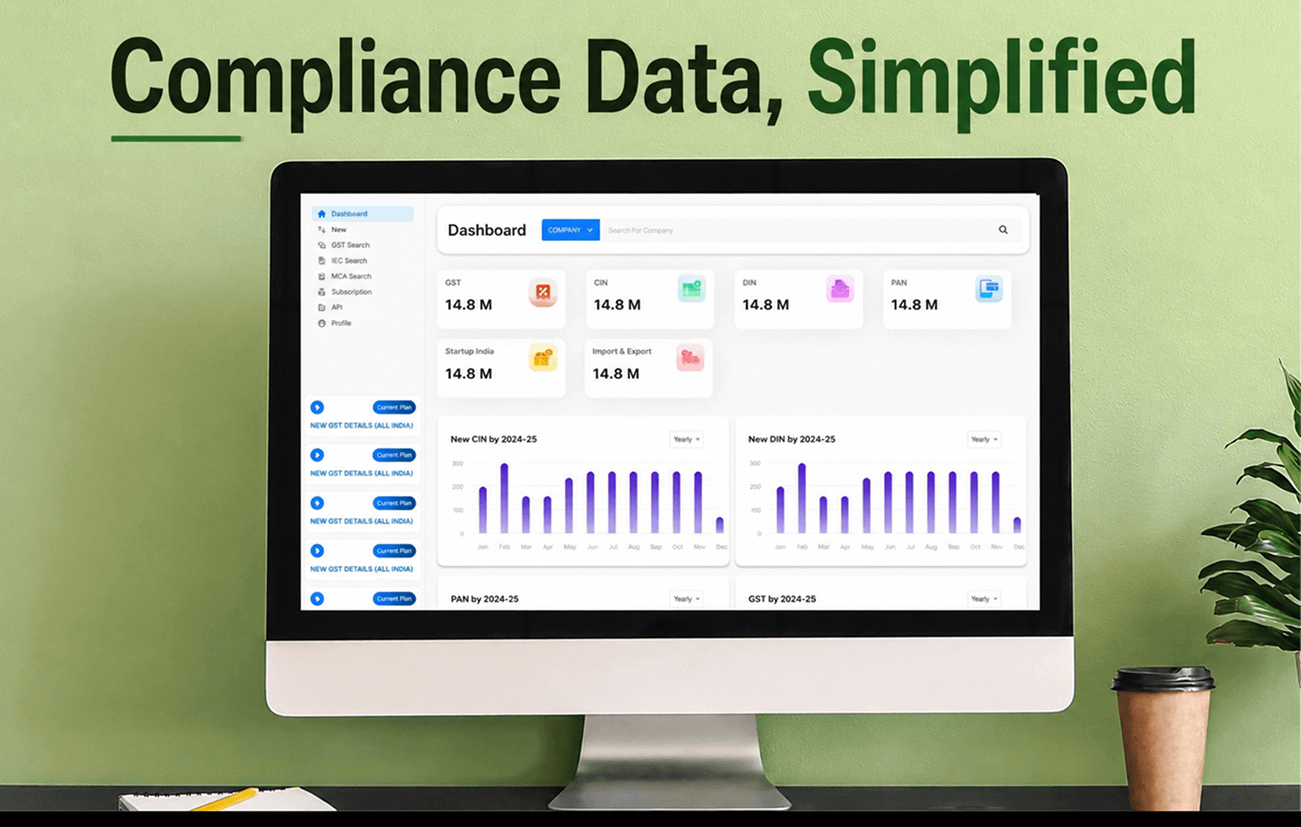
Compliance portal development means building a single screen where a team can verify a CIN, DIN, GSTIN or PAN against government records, store the result with an audit trail, and re-check it later. The hard parts are not the lookups. They are rate limits, caching rules and log retention.
Every procurement team, lender and marketplace in India ends up doing the same work by hand: open the MCA portal, type a CIN, copy the company status, open the GST portal, type a GSTIN, solve a captcha, copy the taxpayer type, paste both into a spreadsheet, repeat two hundred times. A compliance portal replaces that loop with an API call and a stored record. This post covers what it takes to build one properly, with the published prices and documented limits we could verify as of October 2026.
What compliance portal development actually involves
The feature list buyers ask for is short: search a company, see its details, download a report. The system underneath is longer. A working portal needs a normalisation layer that turns four inconsistent government record formats into one internal entity, a credit and billing layer because every lookup costs money, a job queue because bulk uploads cannot run inline, a cache with a defensible expiry policy, role based access so a junior analyst cannot export the full vendor master, and an audit log that records who looked up what and when.
Roughly speaking, the search box is a week of work and everything behind it is the rest of the project. Teams that scope only the search box discover the gap at the point where a client uploads a CSV with 12,000 GSTINs and the request times out.
Four registries, four different behaviours
The four identifiers an Indian compliance portal is usually asked to verify are the GSTIN (tax registration), the CIN (company registration with the Ministry of Corporate Affairs), the DIN (director identification), and PAN. They are not interchangeable, and they do not behave alike.
A GSTIN lookup returns the richest payload. Cashfree’s published response schema for its GSTIN endpoint includes the legal name of business, the centre and state jurisdictions, the date of registration, the constitution of business, taxpayer type, GST status, the last update date, the nature of business activities, and the principal place address. That is enough to populate a vendor record on its own.
A CIN lookup is structurally different. The MCA company master data endpoint in Sandbox’s published API reference returns company name, ROC code, category, sub category and class, authorised and paid up capital, registration date, registered office address, listing status, company status, state code, NIC code and industrial classification. Paid up capital can be absent on LLPIN records, which is the kind of detail that breaks a naive schema on day three.
A DIN lookup returns director level data and is the one most often requested late, usually when someone asks whether a director sits on a blacklist or appears across several supplier entities. Build the data model so directors are a separate entity with a many to many link to companies, not a text field on the company record. Retrofitting that is painful.
What verification APIs cost in India
Most vendors in this space do not publish prices. Of the providers we checked, only the GSTIN specialists list a public rate card. GSTIN API’s published pricing is ₹0.50 per verification below 2,500 credits and ₹0.40 per verification at 2,500 credits and above, pay as you go with no subscription, plus 20 free credits on signup that expire after 30 days. Cashfree states free trial credits worth ₹100 for new accounts, charges only for completed verifications with no setup or maintenance fee, and quotes enterprise pricing on request.
For MCA data, the picture is different. Surepass, Sandbox and Decentro all document CIN and DIN endpoints, and none of them publish a per call price on the product page. The route is a sales conversation. Budget for that, and budget for the fact that a quote you cannot see in advance is a quote you cannot model a unit economic on until you have spoken to three vendors.
| Identifier | Typical payload | Published per call price | Documented rate limit |
|---|---|---|---|
| GSTIN | Legal name, status, taxpayer type, jurisdiction, principal address, business activities | ₹0.40 to ₹0.50 (GSTIN API public rate card) | 100 TPM (Cashfree, Verify GSTIN) |
| CIN | Company name, ROC, class, capital, registered office, status, NIC code | Not published, quoted on request | 100 TPM (Cashfree, Verify CIN) |
| DIN | Director identity and associated company records | Not published, quoted on request | Not published |
| PAN | Name match and status, with wider profile on 360 style endpoints | Not published, quoted on request | 200 TPM sync, 5 TPM bulk (Cashfree) |
Two practical conclusions. First, a portal that does 50,000 GSTIN checks a month is looking at roughly ₹20,000 to ₹25,000 in GSTIN lookups alone at public rates, before MCA data, before hosting. Second, your pricing page has to be built on top of a credit ledger, because your own cost is per call. Flat unlimited plans lose money here in a way they do not in ordinary SaaS.
Rate limits decide your architecture
This is the constraint that most teams meet after they have already written the code. Cashfree’s published verification rate limits are measured in transactions per minute per merchant account: 100 TPM for Verify GSTIN, 100 TPM for Verify CIN, 200 TPM for the synchronous PAN endpoint, and just 5 TPM for bulk PAN verification. Exceeding a limit returns HTTP 429.
Work the arithmetic before you design anything. At 100 TPM, a 12,000 row GSTIN file takes a minimum of two hours of wall clock time even with zero failures. At 5 TPM, a bulk PAN job of the same size takes 40 hours. There is no amount of server capacity that fixes this, because the limit is on the vendor’s side of the wire.
Three consequences follow, and all three are architecture decisions rather than optimisations:
- Every bulk operation is asynchronous. The user uploads a file, gets a job ID, and is notified when it finishes. No progress bar that depends on an open HTTP connection.
- You need a token bucket limiter on your side, set slightly below the vendor’s published ceiling, shared across all workers. Without it, two concurrent jobs will trip 429s for each other and you will spend a week debugging phantom failures.
- Retries need exponential backoff and a dead letter queue. A 429 is not a failed verification. It is a verification that has not happened yet, and the difference matters when a customer is billed per lookup.
The same queue shaped thinking shows up whenever an Indian product has to reconcile outside data on a schedule, which is why the problems here rhyme with real-time inventory sync across multiple suppliers.
Bulk uploads and the queue nobody budgets for
Bulk upload is the feature that sells a compliance portal and the feature that is consistently under scoped. A complete implementation needs column mapping, because no two client CSVs use the same header names; row level validation before anything is sent to a paid API, since a malformed GSTIN that fails a checksum should never cost a credit; partial result handling, so a job with 300 failures out of 12,000 still delivers the 11,700; and a downloadable result file that includes the failure reason per row rather than a blank cell.
Add idempotency keys per row. Users re-upload the same file. Without a key, the second upload bills twice.
Caching: how stale is too stale
Caching is the single largest lever on cost, and the one with real compliance risk attached. The Sandbox MCA reference exposes an x-accept-cache header and an x-source header that selects between primary and secondary sources, which tells you the vendors expect you to cache.
The question is the expiry policy, and it should be set per field rather than per record. A company’s registered name and date of incorporation change rarely. A GST registration status can change to cancelled or suspended at any time, and a stale “active” flag in a vendor onboarding flow is a real liability, not a cosmetic bug. A workable default is a long cache on identity fields, a short cache on status fields, and a visible “last verified on” timestamp on every record in the interface so the user can judge for themselves and force a refresh. Never show a cached status without its timestamp.
Audit logs, RBAC and the DPDP deadline
Compliance portals process personal data, including director names, addresses and PAN details, which puts them squarely inside the Digital Personal Data Protection regime. The DPDP Rules were notified on 14 November 2025 with a phased timeline. In Shardul Amarchand Mangaldas’s reading of the notified Rules, consent manager registration obligations begin on 14 November 2026, and the substantive provisions, covering notice and consent, breach reporting, reasonable security safeguards and data principal rights, take effect on 14 May 2027. The same analysis flags a requirement for data fiduciaries to retain personal data, associated traffic data and processing logs for at least one year from the date of processing.
Read that last point again if you are building now. A one year log retention floor turns the audit log from a nice to have into a schema level requirement, and the penalties attached to this regime are not nominal: up to ₹250 crore for failure to maintain reasonable security safeguards and up to ₹200 crore for failure to notify a breach. We covered the wider obligations in our guide to DPDP Act compliance for Indian app owners.
Practically, that means logging the actor, the identifier queried, the timestamp, the source (cache or live API) and the result status for every single lookup, in an append only table that application code cannot update or delete. Pair it with role based access that separates who can search, who can export, and who can see billing. Export is the permission that matters most: a compliance portal’s export button is, functionally, a database dump of other companies’ data.
A compliance portal development build order
If you are scoping this, the sequence below gets you to something demonstrable fastest without building anything you will throw away:
- One identifier, end to end. Pick GSTIN, because it has public pricing and the richest payload. Single lookup, stored record, audit log entry, nothing else.
- The credit ledger. Before the second identifier. Every lookup debits, every failure that was not billed refunds. Retrofitting billing into a system that already has usage is miserable.
- The job queue and bulk upload. With the token bucket limiter in place from the first day.
- CIN and DIN. Now that normalisation, billing and queueing exist, adding a registry is a connector, not a rebuild.
- RBAC, exports and watchlists. The features that turn a lookup tool into something a team pays for annually.
- Alerting on change. Re-verify watchlisted entities on a schedule and notify when a status flips. This is where the recurring revenue actually sits.
Stages one to three are a genuine MVP and should be treated as one. Our breakdown of MVP development cost in India by stage covers how to budget that sequence without committing to the whole roadmap up front.
What this looks like shipped: Fact Flow
Fact Flow is the compliance portal we built to this pattern. It handles CIN, DIN, GST and PAN record search through API powered lookups, with bulk uploads, saved searches, watchlists and downloadable reports on top. Verification badges, KYC workflows, audit logs and role based access are built in rather than bolted on, alongside uptime monitoring and alerting. Investment platforms carry a stricter version of the same verification layer, which we break down in our guide to KYC AML compliance in India. The build covers an admin panel and a customer panel as separate web applications, which is the right split once billing and support need to see things that customers should not.
The full scope is on the Fact Flow compliance portal case study.
Scoping a compliance portal?
If you are weighing a build against a spreadsheet and a subscription to three separate verification tools, the deciding factors are usually lookup volume, how many people need access, and whether you need a defensible audit trail before May 2027. We scope these as custom software development engagements and will tell you plainly if an off the shelf tool covers your volume. Send us your expected monthly lookup count and the identifiers you need, and we will come back with a build order and a realistic range.
[…] the audit trail and the access controls are the build itself, not an afterthought. Our guide to compliance portal development for CIN, DIN and GST verification walks through the logging and role based access this regime […]
[…] For a non-regulated platform the equivalent flow is lighter: offline Aadhaar XML or DigiLocker for identity, PAN verification for the tax identifier, penny drop for the bank account, and a document trail you can hand to a regulated partner on request. The same engineering discipline applies to the audit trail either way, which is a point we made at length when building a compliance portal that verifies CIN, DIN and GST at scale. […]