

KYC AML Compliance in India: A Developer’s Guide for Investment Platforms
KYC AML compliance for an Indian investment platform means four things in code: verifying PAN and Aadhaar against official databases, identifying beneficial owners at a 10 percent threshold, screening every party against sanctions lists, and filing suspicious transaction reports to FIU-IND within seven working days. SEBI, RBI and the PMLA each dictate a different piece.
Most teams building an investment product discover this stack late. The onboarding screen gets designed around a file upload and a selfie, the engineering estimate assumes a vendor API will handle “KYC”, and then compliance counsel asks who the beneficial owner of a client LLP is and the data model has nowhere to put the answer.
This guide maps the actual obligations to the actual build: which regulator applies to which platform, what each identity check costs at published rates, what the Reserve Bank requires of a video onboarding flow line by line, and where the Digital Personal Data Protection regime pulls in the opposite direction. None of it is legal advice. Use it to scope the work, then have counsel confirm which category you fall into before you ship.
Which rules actually apply to your platform
There is no single Indian KYC rulebook. There are three, and which one binds you depends on what your platform does with securities and with money.
| Platform type | Primary regulator | Core instrument |
|---|---|---|
| Stockbroker, depository participant, portfolio manager, investment adviser, AIF, mutual fund distributor | SEBI | Master Circular on AML/CFT obligations of securities market intermediaries, SEBI/HO/MIRSD/MIRSDSECFATF/P/CIR/2024/78 dated 6 June 2024, plus the KRA validation circular of 14 May 2024 |
| NBFC, bank, payment aggregator, prepaid instrument issuer | RBI | Master Direction on KYC, 2016, as amended by the KYC (Amendment) Directions, 2025 dated 12 June 2025 |
| Any reporting entity as defined in the PMLA | FIU-IND | Prevention of Money-laundering (Maintenance of Records) Rules, 2005 |
| Deal discovery, investor matching and data room platforms that hold no client money and deal in no securities | None directly | Contractual. Your broker, AIF or escrow partner is a reporting entity and will push equivalent checks onto you |
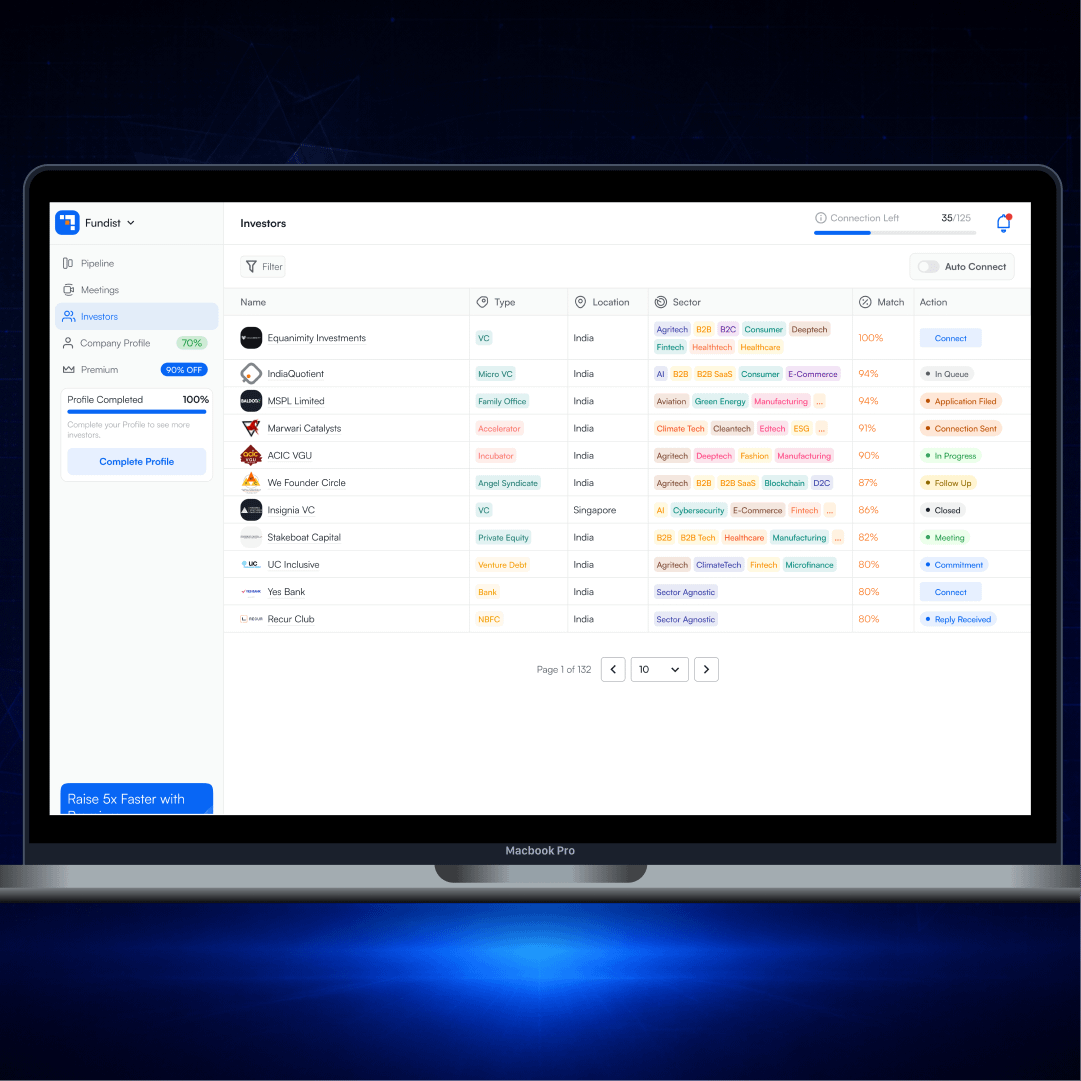
That last row catches more founders than the first three. A platform like Fundist, the investor matching product we built, sits between founders and investors with NDA-protected deal rooms rather than a trading book. It is not a reporting entity on its own. It still needs verified identity on both sides, because the counterparties on the far end of every introduction are regulated and their diligence flows upstream.
Worth knowing for context: the FATF, APG and EAG joint assessment published on 19 September 2024 placed India in regular follow-up, the best of the available outcomes, with high technical compliance. The same report flags domestic politically exposed persons as only partially compliant and notes that smaller financial institutions lag commercial banks in applying preventive measures. Expect scrutiny of exactly those two areas to tighten, not loosen.
KYC AML compliance: the four checks and what they cost
Four lookups carry almost all the weight. Three of them have published rate cards, which means you can budget them properly instead of taking a vendor’s blended per-KYC price on faith.
| Check | Source of truth | Published cost |
|---|---|---|
| PAN validity and name match | Income Tax Department, via Protean Online PAN Verification | ₹12,000 plus 18 percent GST a year (₹14,160) for registration, 750 PANs a day free, then 30 paise per PAN, falling to 5 paise above 30 lakh PANs a year |
| Aadhaar e-KYC, OTP or biometric | UIDAI, through a KUA or sub-KUA | ₹3.60 per successful e-KYC from 1 November 2025, ₹0.60 per failed e-KYC, ₹0.60 per Yes/No authentication, under the Aadhaar (Payment of Fees for Performance of Authentication) Regulations, 2023 |
| Reuse of an existing KYC record | CKYCR, operated by CERSAI | Search free, first download ₹2.25, repeat download of the same record ₹1.00, plus GST, per CKYCRR notification CKYC/2024/10 effective 1 January 2025 |
| Securities market KYC status | A SEBI registered KRA | Charged to the registered intermediary under the KRA regulations. No public rate card |
| Bank account ownership, penny drop | Banking rails via a licensed partner | Quoted per call by the vendor. No public rate card, so budget from written quotes |
Two implications fall straight out of that table. First, CKYCR download at ₹2.25 is cheaper than a fresh Aadhaar e-KYC at ₹3.60, and the RBI’s June 2025 amendment now expects regulated entities to download existing records from CKYCR with customer consent at onboarding rather than re-collecting everything. Search costs nothing, so searching CKYCR before you start a new collection flow is free and should be the first branch in your onboarding state machine.
Second, Aadhaar e-KYC is not open to everyone. You reach UIDAI through a licensed KUA or sub-KUA, and direct access by a non-government entity runs through the Aadhaar Authentication for Good Governance Amendment Rules, 2025, notified on 31 January 2025. Under those rules a private entity applies to the relevant ministry through a designated portal, UIDAI examines the application and recommends, and MeitY approves. That is a process with a calendar attached to it, not a sprint task. Plan the offline Aadhaar XML and DigiLocker path as your default and treat live e-KYC as an upgrade.
Building the onboarding flow: V-CIP and the alternatives
If you are a regulated entity, the Video based Customer Identification Process is the fully digital onboarding route, and the RBI Master Direction on KYC specifies it in enough detail that it reads like a technical requirements document. The requirements that most commonly get missed in a first build:
- The recording must carry live GPS coordinates and a date and time stamp. Geotagging is not optional and cannot be inferred from the IP address.
- Face liveness and spoof detection plus face matching are both required. A still selfie compared to an ID photo does not satisfy this.
- Question sequences must vary between sessions so the interaction is demonstrably live. If the official prompts the customer, the account opening is rejected.
- Connections from IP addresses outside India, and spoofed IPs, must be blocked. End-to-end encryption is required from the customer device to the hosting point.
- All recordings and data must be stored on systems located in India, with stamps that make them searchable, and the activity log plus the operating official’s credentials must be preserved.
- An Aadhaar XML file or QR code used for offline verification must be no more than three working days old at the time of the session.
- If the session cannot finish in one go, the video process must complete within three working days of obtaining the identification information. A pause is fine; a call drop means a new session.
- Accounts opened through V-CIP become operational only after concurrent audit, and the infrastructure needs vulnerability assessment and penetration testing by CERT-In empanelled auditors.
Read that list as architecture, not as paperwork. “Operational only after concurrent audit” means your account state machine needs a state between created and funded. “Three working days” means a session has a business-day expiry, which means you need a holiday calendar in the backend. “Stored in India” means a region decision you cannot revisit cheaply later.
For a non-regulated platform the equivalent flow is lighter: offline Aadhaar XML or DigiLocker for identity, PAN verification for the tax identifier, penny drop for the bank account, and a document trail you can hand to a regulated partner on request. The same engineering discipline applies to the audit trail either way, which is a point we made at length when building a compliance portal that verifies CIN, DIN and GST at scale. Once those counterparties are verified and need to read confidential documents, the next layer is secure deal room development, which covers NDA gating, role-based permissions and audit trails.
Beneficial ownership: the 10 percent rule that breaks schemas
The single change that most often forces a data model rewrite is the beneficial ownership threshold. SEBI’s master circular of 6 June 2024 took the threshold for companies down from 25 percent to 10 percent, and for partnerships and other entity types from 15 percent to 10 percent.
At 25 percent, a non-individual client has at most three beneficial owners and a flat table works. At 10 percent, a client can have nine, holdings routinely sit behind two or three layers of holding companies, and the thing you are modelling is an ownership graph with recursion and cycles, not a list.
Design for that from the start:
- Model ownership as edges between parties with a percentage, an as-of date and an evidence reference, not as columns on a client record.
- Compute effective ownership by traversing the graph and multiplying along each path, then summing paths that reach the same natural person.
- Store the senior managing official as an explicit fallback, because the rules expect one when no owner crosses the threshold.
- Version everything. A beneficial owner at onboarding and a beneficial owner today are different facts, and you will be asked to prove both.
- Re-run the computation on a schedule, not only at onboarding. Cap tables change without anyone telling your platform.
Screening, monitoring and reporting to FIU-IND
Identity verification is the easy half. The obligations that actually carry penalties are ongoing.
Screening comes first. SEBI’s 2024 master circular requires intermediaries to screen transacting parties against the designated list maintained under Section 12A of the Weapons of Mass Destruction Act, halt the transaction on a match, and report it to FIU-IND without delay. In system terms that is a synchronous blocking check in the transaction path, not a nightly batch job, and it needs a list refresh mechanism plus an audited record of every match and every clear.
Reporting timelines are fixed by rule, and the FIU-IND AML and CFT guidelines set them out:
- Suspicious transaction reports: within seven working days of being satisfied that a transaction is suspicious, under Rule 8(2). The clock starts at formation of suspicion, so your case management system needs to timestamp that moment, not the moment the report is filed.
- Monthly reports: by the fifteenth day of the succeeding month, under Rule 8(1).
- Record retention: at least five years after the business relationship ends or the account is closed, whichever is later, under Section 12(3) of the PMLA. Identification documents collected during customer due diligence carry the same five-year floor.
SEBI also now expects documented risk assessments, kept current and producible to the regulator on request, group-wide AML programmes where a financial group exists, and explicit conditions before you rely on a third party for customer due diligence, including that the third party is regulated and not based in a high-risk jurisdiction. If your plan is to outsource diligence to a vendor, that last clause is the one to read twice.
One SEBI-specific trap for securities platforms: under the KRA validation circular of 14 May 2024, a KYC record only counts as validated when its attributes are verified against official databases and PAN-Aadhaar linkage is confirmed under Rule 114AAA of the Income Tax Rules. Records that are not validated are not portable between intermediaries, and clients whose attributes cannot be verified are not permitted to transact further. Your UI needs to distinguish those states clearly, because a user who thinks they are onboarded and cannot trade will raise a support ticket every single time.
KYC AML compliance and the DPDP Act
The two regimes pull against each other, and the collision is now on a calendar. The Digital Personal Data Protection Rules were notified on 13 November 2025. Consent manager registration and obligations begin twelve months later, and the substantive compliance rules, including Rules 3 and 5 to 16, come into force around 13 May 2027.
Three conflicts matter for a build:
- Retention. DPDP points toward erasing personal data once the purpose is served. The PMLA requires five years past the end of the relationship. The legal obligation ground is what reconciles them, which means your retention policy has to be written per data category with the statute named against each one, not set as a single global TTL.
- Video recordings. A V-CIP session is a face, a voice, a location and an identity document in one artefact. The RBI already requires it to live on servers in India. Treat it as your highest sensitivity class, with separate access control and its own access log.
- Consent text. Aadhaar consent, CKYCR download consent and DPDP notice are three different requirements and should be three separate, versioned, retrievable artefacts tied to the exact consent string the user saw. We covered the notice and erasure mechanics in detail in our breakdown of what the DPDP Act requires of Indian app owners.
Verification fees are one line in a much larger regulatory budget. We priced the rest of it, including RBI net worth floors, CERT-In audits and the DPDP engineering work, in our breakdown of fintech app development cost in India.
A 10-point implementation checklist
- Confirm with counsel whether you are a reporting entity under the PMLA. The answer changes the entire scope.
- Search CKYCR first. It is free, and a ₹2.25 download beats a ₹3.60 fresh e-KYC and a 10-minute user flow.
- Register for Protean Online PAN Verification early. It is an annual ₹14,160 commitment with its own approval step.
- Build the offline Aadhaar XML and DigiLocker path as the default, and treat live e-KYC access as a separate project with its own timeline.
- Model beneficial ownership as a versioned graph at the 10 percent threshold, with a senior managing official fallback.
- Put sanctions screening in the synchronous transaction path with an audited record of every match and every clear.
- Timestamp formation of suspicion separately from filing, so the seven working day clock is provable.
- Write retention policy per data category with the governing statute named, not as one global rule.
- Design account states for the gap between created, validated and operational. Concurrent audit and KRA validation both live in that gap.
- Budget the CERT-In empanelled audit and the India-region hosting decision into the first release, not the second.
Done properly, KYC AML compliance is roughly a third of the engineering effort in a first release of an Indian investment platform, and almost none of it is visible in the product demo. That is the part founders underestimate when they scope the build, and it is a large slice of why fintech timelines run longer than the generic benchmarks in our breakdown of MVP development cost in India.
If you are scoping an investment, fundraising or wealth product and want the compliance layer costed properly before you commit to a timeline, talk to our custom software development team in New Delhi. We will map your platform to the right regulator, size the verification stack against published rates, and tell you plainly which parts need a licensed partner rather than a line of code.
[…] went through the rule set in detail in our guide to KYC and AML compliance for Indian investment platforms. The short version for budgeting: the per-check fees are visible and the reviewer headcount is not, […]
[…] 2 and 3 carry the most weight. If you are building in a regulated vertical, the KYC and AML implementation guide goes deeper on the verification stack behind […]